Showing posts with label retrospectives. Show all posts

Tuesday, 8 July 2014

Kanban in IT: Why You're Probably DOING IT Wrong!

Despite it's age, especially in other fields, Kanban is a relatively new addition to the IT world. As someone who is easily just as inquisitive about the development process and working more effectively and systemically, when Kanban was mentioned all those years ago, I looked at the history of the process, put my mathematical hat on, my searching boots on and started to try to understand these systems in more detail.

For those who are not familiar with Kanban, it originated in the manufacturing world. Specifically, it stemmed from the study of supermarket demand in the 1940s which and later became the Toyota production system (TPS) in Taiichi Ohno's seminal work from 1988. Get that? Started in the 1940's! Some 60 years before IT ever got its hands on the idea.

The method became arguably the most solid foundation in Just-In-Time manufacturing bringing unparalleled and unmatched production quality and speed to the Japanese car market. As a child of the 80s, I remember the sheer envy of the rest of the world of the Japanese market, which at the time outshone the German market for efficiency. It even caused a plethora of Hollywood films about firms being subsumed (aiming to, or avoid) by Japanese companies, such was the dominance of the Japanese car market at that point.

Additionally, whatever you think of process improvement methods, Lean-Six Sigma and Kaizen both use Kanban process as cornerstones of process improvement techniques & there are a number of mathematical and statistical studies of the technique which have also delivered some heuristics to follow. So again, old hat.

As a software development professional, I use Kanban all the time and as an agile early adopter, I have done for a good, long while. However, one thing that always crops up, which I believe is fundamentally wrong, is the notion of tickets moving across the board as the work items themselves. I often have to reiterate the ticket isn't the work item, it's a representation of the needs of the work item. A Kanban signal!

Now, in true [just after] 80s style, you can watch some videos explaining the manufacturing equivalent of the pull system:

https://www.youtube.com/watch?v=w3Ud7pEhpQM

Kanban has been used in manufacturing, healthcare, baking etc. and the only one that I admit to taking umbrage at is the software dev Kanban and here's who. Pay particular attention to how this works! A key takeaway is that information flow, the ticket which includes the 'specification' of the batch size/container, flows from right-to-left, whilst the implementation (real thing) flows from left-to-right.

Self-flagellation? 

No, I believe in being realistically critical enough about our own work to find the points for improvement. Admittedly, some folk see this as me being negative and make no mistake, there are times I am especially when trying to get some teams to think about change is like head-butting a wall over and over or swimming through treacle - There are only so many times you can keep head-butting that wall before you cease to add value. So companies without the necessary buy-in can learn the hard way when their competitors overtake them and if some staff then leave or are made redundant, they company and staff find themselves without the requisite skill-set to compete with other candidates on the market. It is a huge problem in the IT world especially and one of the reasons why some people were forced out of the industry as agile methods took over.

We also need to reframe this as learning, not criticism. Especially when considering (For those of us lucky enough to have some understanding of optimisation), a theoretically optimal system isn't guaranteed to be unique in any situation! So you can get more than one optimum so there is more than one right answer at the time. In the case of manufacturing or economic systems, this is because there are often more variables than there are equations to solve them (implicit or explicit). So this naturally becomes an optimisation problem with almost always more than one solution, but those solutions do exist and can be found through iterative methods. 

Whilst I was involved in the creation of the mathematical algorithm and ran that derivative of IPFP for the UN Development Programme's JOrdanian Social Accounting Matrix in 2012 (based on matrix-raking - it's an iterative algorithm) Kanban modelling doesn't need that level of sophistication. For a lot of problems Linear programming is a sufficient way to look at these systems. However, this is outside the scope of this article, as much as it pains me to say it :) So I'll stick with giving you top-3 tips, but assume you're already segmenting customer feature end-to-end (i.e. entire thin Lines of Business).

TOP-3 TIPS


1. Kanban is a Pull-System

CORRECT! It very definitely is a pull system! So why are you pushing cards across a board? Stop doing it! Think about how you can signal that a task is ready to be pulled. Some folk use smaller green stickers/tiny post-it notes etc. 

In my mind, and this isn't shared by everyone (but everyone has been wrong before ;), the ticket represents a container for the item you're producing (whether that is a feature of a system, with many features going into an epic container for the MMF or MVP) or a physical item, such as a container for a 'Login page'. The item is not the login page itself.

The filled container is what the customer wants. If you're Kanban process looks like the following deliberately not perfect example:
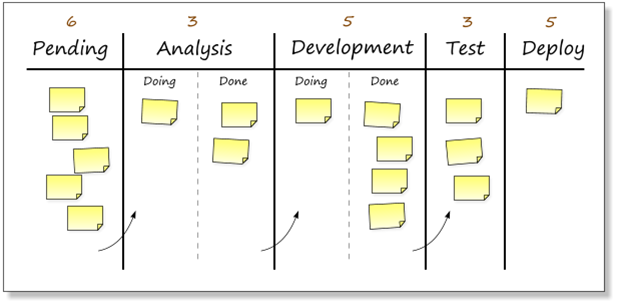
image from bob's lean learning

The arrows represent where the items go when they are pulled form the previous stage, not pushed once done. At the end of the flow, the deployed container is what the customer gets. The customer pulls this from the test stage once it's ready, which pulls this from the development stage once it's ready, which pulls this from the analysis stage once it's ready, which pulls the 'material' from the pending backlog once it's ready. The specifying pull-signal moves from right-to-left. From customer needs, which effectively specify the acceptance criteria for the system through behavioural tests (BDD/Gherkin) or even just BOLT ("As a... I want... so that...") through to picking up the raw materials (tools, projects, repos etc) at the very beginning. You'll note one crucial and perhaps controversial thing... DEVELOPMENT IS NEXT TO LAST!!!!

Before you start shouting off, this doesn't mean that developers are last, inferior or can be demeaned. After all, you're working in multi-function teams and this is a stage not your job or role right? 

Even if you are in charge of it and are feeling insulted or devalued now, ask yourself why that is? Are you protective over your role in the team? Is it Test-Driven Development you are practising? If so, what do you think that truly means? Does the customer care (or is their value measured) by the teasing out or refactoring of tasks which don't pass acceptance tests, glean feedback or deliver much needed value? No, of course not (you better agree!) because the old agile statement about the code being the final arbiter is complete rubbish and has been one that I've thought ridiculous from the start! Whether it delivers value is the true arbiter of the worth of the code and the efficacy of the team. All those feelings of anxiety that may manifest are indicators of 'threat' and dare I say, were felt by the people who were told to move to agile environments some 15 years ago at the turn of the millennium. Indeed, I myself felt them at the time and there is an important lesson in that.

Take a look at this video for 5S a lean manufacturing improvement vendor and see if you can spot some of the things which also conceptually apply to software development (SPOILER ALERT! "All of them") then think about how this can applied in your org:


Or how about this video of a an office space? I think there were more points in this for improvement (HINT: the business cards)


WATCH FOR: No visual indicators of 'ready', usually accompanied by people moving cards into the in-tray of the next stage to the right once complete. This is the same as using 'in-trays' and runs counter to Kanban. QA not being involved (or taken seriously at retrospectives).

TIP: Get small stickers or post-its to show that a task is ready to be pulled, or perhaps have a sub-column for tasks that area ready.

2. Pull-Signals Flow Right-To-Left

Information in the form of pull-signals makes its way from the right hand side of the board to the left hand side of the board. Compare this with a manufacturing plant, where different stages in the process often have differing levels of local inventory, for different parts of the whole. For example 4 screws are used to mount a single kickplate on a door which is pulled as a trolley of doors and kickplates, with the screws at the bench.

In software development a feature is a particular item of meaningful functionality. After going 'backwards' through the testing stage (which remember, is just the container/pull-signal for the work) this may get broken down into smaller architectural chunks, which may have TDD tasks wrapped around them. 

Can you see what I am suggesting here? Yes, QAs are effectively your architects. If you're a developer, then I expect there's PANIC! But again, it is TDD you're practising right?...

The truth of the matter is the market isn't currently aligned to this idea at all. Companies still value testers much less than they do development staff and as a result, most people with development skills do not move into testing roles else they earn around 17% less in salary terms, though the contract market is much better aligned. Until this changes, the motivation for better, more technical test staff will simply not be there.

WATCH FOR: Classic indicators of this are where developers run (and talk most at) the stand-ups, a developers is, say, a Scrum master or team lead, the developers drive change, look at technology choices before customer value, the retrospectives are not data driven or are otherwise poor and the team use only one type of testing process (such as TDD) with no attention to behaviour, increment size, load and/or performance testing. Whilst not exclusively the preserve of developers, it indicates both siloed thinking in job role and no strength being attributed to the test side of the team.

TIP: Encourage buy in from the team and make them aware that the QAs run the testing process. Encourage pairing for KTP and the breaking down of features led by the testers, not the development staff.

3. Business Analysts are also your Feedback!

More often than not, a business analyst is found on a team and they illicit requirements. They also look at the business process at hand and determine the value of the tasks but rarely do I see a business analyst be involved in decisions and reporting ROI and team and capability effectiveness. This is the missing link.

When working lean, the aim is to get feedback on how well the business vertical is working. A business analyst does exactly that! They have to look at the customer value of each and every story and determine the cost-benefit of doing each [thin business vertical] task. They will also help determine the Rate-Of-Return and the Return-On-Investment of a project in the customer's mind as well as look at the customer experience elements, both inside the outside the team. Together with the QA's they are crucial in determining how effective the team are, how well they are working together and determining the scope, location and exposure to any points of waste or constraints in the process. They will be skilled at determining the appropriate contextual metrics and constraints (a bank is different to a mobile social media app start-up) and monitoring the necessary measures of value.

WATCH FOR: Retrospectives without numbers or no change in waste, blockers or bug numbers in each iteration over a period of time or no predictability in flow. This is likely nearly every one you'll ever attend (and is why they're wrong). Some companies, such as Lastminute.com have moved up a level, but they are very very rare!

TIP: Get the business analyst to think about operational expenditure and how the team adds value. If you take the brave (but I think legitimate) step of align reward to profitability, then the business analyst will be crucial in determining that for the team. This will include finding the internal independent variables influencing flow, cycle-time and throughput/velocity, such as number of blockers, bugs, enhancements and other levels of waste.

Summary

Moving to lean from just plain agile is a tough ask for a lot of companies anyway, whichever field they're in. This article gives you necessary but not sufficient things to look for when walking the floor at your company. 

Note, there are better companies out there than us in other fields and we are guilty in the IT world of not being humble enough to understand that. It isn't that the problem of Kanban is any different in software or product development (at least I can't see a significant difference), just that our grasp about what a batch or container is, is very muddy. We can and do use story points, but need to attach these to features which combine into epics and hence make up MVPs and MMFs. Other techniques such as creating thin slices of functionality reduce the variance enough to introduce a reasonable element of predictability into the container or batch size. 

We also think that development is the cornerstone of the business, which any CEO will tell you, isn't true. It's an enabler, often to a product or service which pre-dates computers. If they could get something to do it as fast, but without the development overhead, they'd choose it over developing software any day, as there is much greater uncertainty in software. We already see this inside the IT space with build or buy decisions. So the role of business analyst and QA is crucial in process optimisation and it certainly isn't the preserve of the development team.

Teams inside and outside organisations need to make sure they understand that they are also part of the value chain. Your customer takes a problem, adds value in the solution they create (which includes the software they get you to write) and 'sells it on', providing a solution to their own customers, who may be Joe Public. If you've worked in B2C or B2B service companies before, this is always the case. Being in IT doesn't lose you the economic reasoning and truth be told, in capitalist environments, I think that's unforgivable if you think that's the case. 

Happy Leaning!

Sunday, 18 August 2013

Evolutionary Estimation

This is a topic that I've started but had to park numerous times, as timing has simply not been on my side when I've had it on the go. I started to think about the mathematics of Kanban a couple of years ago as I got frustrated by various companies being unable to get the continuous improvement process right and not improving their process at all. The retrospectives would often descend into a whinging shop, sometimes even driven by me when I finally got frustrated with it all.

In my mind, cycle-time and throughput are very high level aggregate value indicators which is often measured in the world of the client by a monetary sum (income or expenditure), target market size or some risk indicator. To throw out the use of analytical processes and indeed mathematics as traditional process driven 'management' concepts is fatal to agile projects, since you are removing the very tools you need to measure alignment with the value stream that underpins the definition of agile value, not to mention violate a core principle in agile software development by losing the focus on value delivery to the customer.

I won't be covering the basics of continuous improvement, that is covered by many others elsewhere. Suffice to say that it is not a new concept at all, having existed in the world of manufacturing for over 40 years, in Prince 2 since the mod-to-late 90s and process methods such as Six-sigma, maturity models such as CMMI, JIT manufacturing (TPS we all know about) etc.

In software, it is really about improving one or both of the dependent variables of cycle-time and throughput (aka velocity) and often takes place in the realms of retrospectives. I am not a fan of the flavour of the month of just gathering up and grouping cards for good-bad-change or start-stop-continue methods, as there is often no explicit view of improvement. It affords the ability to introduce 'shiny things' into the development process which are fun, but has a learning lag time which can be catastrophic as you head into a deadline as the introduction of a new technology introduces short-term risk and sensitivity into the project. If you are still within that short-term risk period, you've basically failed the project at that point of introduction, since you are unproductive with the new tool, but have not continued at full productivity on the old tool. Plus, simply put, if you want to step up to work lean, you will have to drive the retrospective with data, even if it is just tracking the throughput and cycle-times and not the factors on which it depends (blockers, bug rates, WiP limits, team structures etc.)

I have written quite a bit of stuff down over the last couple of years and so I am going to present these as a series of blogs. The first of them here covering improved estimation.

Let Me Guess...

Yes, that's the right answer! :-) Starting from the beginning, especially if like me, you work as a consultant and are often starting new teams, you will have no idea how long something is going to take. You can have a 'gut feeling' or draw on previous experience of developing similar or not so similar things, but ultimately, you have no certainty nor confidence in how long you think a task is going to take.

The mathematical treatment of Kanban in software circles is often fundamentally modelled using Little's Law, which is a lemma from the mathematical and statistical world of queuing theory. In it's basic form, it states that the average WiP items (Q) is the resulting arrival rate of items into the backlog (W. and when stable, this is also the rate at which it moves into 'Done' - aka throughput in unit time) multiplied by the average time the ticket, a story point or whatever (as long as it is consistent with the unit of throughput) spends in the pipeline, aka its cycle-time (l).

Q = lW

Little's Law can be applied to each column on the board and/or the system as a whole. However, here's the crux. The system has to be stable and have close to zero variance for Little's law apply effectively! Any error and the 'predictive strength' of the estimate, which most clients unfortunately tend to want to know, goes out of the window. After all, no project has ever failed because of the estimate, it is the variance from the estimate that kills it. Reduce the variance, you reduce the probabilistic risk of failure. A variance is simply:

V = | A - E |

Which is the absolute difference (don't care about negatives) between the actual and estimated points total or hours taken. You have some choices to reduce the variance and bring the two into line. Improve your estimates, deliver more consistently or indeed both.

However, Kanban has been modelled to follow a slightly more general model, where a safety factor is included in the equation. In manufacturing and in software, safety is very often (but not always) associated with waste. The equation basically adds a safety factor to Little's laws, thus allowing for variance in the system. So it looks more like:

Q = lW + s

Aside from many things, Kanban helps to introduce lean principles into the process and eventually, aims to reduce the safety factor, making it reliable enough to be modelled by Little's law, where the mental arithmetic is not as taxing :-)

Part of doing this in software, is reducing the need to have slack in the schedule, which in turn is dependent on the variance in the system. Getting better at reducing the variation and eventually the variance, improves the understanding, accuracy and reliability of the estimates and this is the part I'll cover today.

What's the point?

I have never really been a fan of story point for the reasons that have been given by the practising agile community. The difficulty is that unlike the use of hours, as inaccurate as they are, they don't have an intuitive counterpart in the mind of the client and are simply too abstract for developers, let alone customers, to get their head around, without delivering a corresponding traded-off benefit for that loss. Effectively, a story point also introduces another mathematical parameter. This is fine for maths bods, and I certainly have no issue with that, but there isn't actually a need to measure story points at all. Story points violate the KISS principle (or for true engineers, Occam's Razor) and inherently make the estimation and improvement process more complex again, without a corresponding increase in value apart from maybe bamboozling management. What doesn't ever come out is how bamboozled the development team also are :-)

It's no great secret that despite including the use of story points in the first edition of XP Explained, Kent Beck moved away from the use of story points and back to hours in his second edition, much to the dismay of the purists. In my mind, he simply matured and continuously improved XP to use a better practise (which has it's roots in a previous practise) and so personally lives the XP method. He gained a lot of respect from me for doing that. That said, points aren't 'point-less' but if you wish to use points, you need to get to the... erm... point of having some form of consistency in your results... OK, I'll stop the puns :-)

For those experienced in the lean start-up method, there is a potential solution to the metrics which removes some of the unknowns. Following on from the above discussion around variance, consider one of the team's Kanban metrics to be measurable by the width of the standard deviation. The metric would be to repoint/reestimate tasks based upon the validated knowledge of what you find from the continual experiments with the estimation->adjustment cycle, until you achieve normally distributed (or t-distributed if the number of data points is below about 25) 1-point, 2-point, 3-point, 5-point,... data. That will then allow you some leeway before then evolving to make the distribution as narrow as possible.

For example, the A/B-test for the devs would be to set the hypothesis that taking some action on estimation, such as re-estimating some tasks higher and lower, given what they have learned about somewhat similar delivered stories will yield a narrower variance, hence a better flow, reduce risk and improve consistency (especially to the point where the variance from Little's law becomes acceptably small). This would take place in the retro for each iteration, driven by the data in the process.

In the spirit of closing a gap a conversation and hence improving the quality of that conversation, for a product owner, manager or someone versed in methods such as PRINCE 2, PERT, Six-sigma, Lean or Kaizen, this will be very familiar territory and is the way a lot of them would understand risk (which in their world, has a very definite value, most obviously where there is a financial consequence to breaching a risk threshold). As time goes on, you can incorporate factor analysis into the process to determine what factors in the process actually influence the aggregate metrics of throughput and cycle time.

Show me the money!...

No, because it varies on a number of factors, not least the salaries of the employees. To keep the discussion simple, I'll attach this to time. You can then map that to the salaries of the employees at your company and decide what the genuine costs and savings would me.

Imagine the following data after some sprints. This is fabricated point data from 2 sprints, but is still very typical of what I see in many organisations.

table 1 - initial 2 x 4-week sprints/iterations worth of data 

From this you see next to nothing. Nothing stands out. However, let's do some basic analysis on it. There are two key stages to this and they are:

  1. Determine the desired 'shape' of the distribution from the mean and standard deviation in the current data
  2. Map this to the actual distribution of the data, which you will see is often very different - This will give you an indication of what to do to move towards a consistent process.
You'll note that I deliberately emphasised the word 'current'. As with any statistic, it's power doesn't come from predictability per se, it comes from it's descriptive strength. In order to describe anything, it has to have already happened. Lean Start-up takes full advantage of this by developing statistical metrics without using the term, as it may scare some people :-)

So, from the above data we can see that we have more than 25 data point, so we can use the normal distribution to determine the shape of the distribution we would like to get to. The following graph shows an amalgamation of the normal distribution of time taken for each 1 to 8 pointed ticket up to the last sprint in the data set (if you work on the premise that 13 points is too big and should be broken down, then you don't need to go much further than 8 points, but that threshold depends on your project, team, and of course, how long things actually take). The overlaps are important, but I will come back to why, later.

fig 1 - Points distribution in iteration 1

Having got this, we then plot the actual distribution of the data and see how well it matches our normals.

IMPORTANT ASIDE
As well as showing that the overlap of the normals mean that a task of 4 days could have been a one point of an 8 point task, causing unpredictability, for the points themselves the distribution above also shows a very interesting phenomenon and that is the informal ratio of the height against width of each peak. The distributions may well even have the same number of data point (you get that by integrating the areas under the distributions or of course, using normal distribution tables or cumulative normal functions in Excel), but the ratio intuitively gives you a sense of the variance of the estimation. The narrower the better and it shows our ability to estimate smaller things better than larger things.

I often illustrate this by drawing two lines. One small (close to 2cm) and one much larger (close to 12cm) and ask someone to estimate the lengths of the lines. The vast majority majority of people come within 10% of the actual length of the small line and 25 - 30% of the bigger line. It's rare that estimations are the same for both sizes. This is why taking on smaller jobs and estimating them also works to reduce risk, because you reduce the likelihood of variance in the number of points you deliver. Smaller and smaller chunks.


Anyway, back to the distributions. Using the original table, do the following look anything like normal?

fig 2 - Actual distributions

If you said yes, then..., ponder the difference in weight between a kilogramme of feathers and a kilogramme of bricks.

OK, I'm being a bit harsh. In some of the distributions we're almost there. It's easier to see the differences when you take into account the outliers and in these distributions, it is pretty obvious when you consider the kurtosis ('spikiness') of the corresponding curves. Kurtosis is the spikiness of the corresponding curves (approximating these discrete distributions) against the normal distribution for that data. It's easier to see this on a plot, again using Excel.

fig 3 - first generation estimates

As expected, we're pretty close with the 1 point stories, partly because of the reasons mentioned in the previous aside. The 2, 5 and 8 point estimations, whilst quite unpredictable show something very interesting. The kurtosis/spikiness in the curves are the result of peaks on either side of the mean. These are outliers relative to the main distribution. These are what should be targeted to move into other point categories. The 4, 5 and 6 day tasks which resulted from the 5-point estimates are actually more likely to be 3 point tasks (read the frequencies on the days in each graph). The same is true for the 1, 2 and 3-day, 2-point tasks as these are much more likely to be 1 point tasks. This is also the case when looking for data to push to higher points. 

What are you getting at?

Estimation is a process we get better at. We as human beings learn and one of the things we need to do is learn the right things, otherwise as we search for cognitive consonance to make sense of any dissonance we experience, we may settle on an intuitive understanding, or something that 'feels right' which may be totally unrelated to where right actually is, or a positions which is somewhat suboptimal. In everyday life, this leads to things like superstition. Not all such thoughts is incorrect, but in all cases, we need to validate those experiences, akin to how hypotheses are validated in lean start-up.

In this case, when we push the right items, the right way, we then get a truly relative measure of the size of tasks. At the moment, if we are asked "how big a task is a 2 point task?" we can only answer "It might be one day, or it might be 8 days, or anything in between". Apart from being rubbish, it has the bigger problem that if we are charging by point, we have no certainty in how much we are going to make or lose. As a business, this is something that's very important to know and we need to get better at. For those who work as permanent staff, have a salary for the predictability and surety and a business is no different.

The statistical  way to assess how good we have become at estimating is to use goodness of fit indicators. These are particularly useful in hypothesis testing (again very applicable to Lean Start-up again). The most famous being the r-squared test, most often used for linear regression, but can be used for normal distributions and also the chi-squared tests, which can be applied to determine if the distributions are normal. We can go further by using any L-norm we want. For those that have have worked with approximation theory, this is fairly standard stuff, though I appreciate it isn't for everyone and is a step further than I will go to here. The crux is better our estimates and actuals fit, the better the estimating accuracy and the better the certainty.

OK, I push the items out, what now?

Cool, so we're back on track. You can choose how you wish to change point values, but what I often do is start from the smallest point results and push these lower outliers to lower point totals, doing this for increasing sized tickets, then starting from the high valued tickets and working backwards, push the upper outliers on to higher valued tickets.

All this gives you a framework to estimate the immediate-future work (and no more) based on what we now collectively know of these past ticket estimates and actuals. So in this data, if we had a 2 point task that took 1-day, it's likelihood is actually that it is a 1-point task, given the outlier. So we start to estimate those tasks as one point tasks. The same applies to the 6 and 7-day 2-point tasks as they are most likely 3-point tasks. If you are not sure, then just push it to the next point band, as if it's bigger it will shift out again to the next band along in the next iteration or if it is smaller, as we get better at estimating, it may come back.

Assuming we get a similar distribution of tasks, we can draw up the graphs using the same process and we get graphs looking like:

fig 4 - Second generation estimates, brought about by better estimations decided at retros.

As we can see, things are getting much smoother and closer to the normal we need. However, it is also important to note that the distribution of the old expected from the now actual has shifted and so has the normalised variance and mean of the distributions themselves (i.e. the normal distribution curves in blue have themselves shifted). This is easier to illustrate by looking at the combined normals again. So compare the following to figure 1.

fig 5 - Second generation normally distributed data

So our normals are spacing out. Cool. Ultimately, what we want it to rid ourselves of the overlap as well as get normally distributed data. This is exactly the automatic shift in estimation accuracy we are looking for and is touted by so many agile practitioners, but is never realised in practise. The lack of improvement happens because retrospectives are almost never conducted or driven by quality data. It is the step that takes a team from agile to lean, but our validated knowledge on our estimates, together with the data to target estimation changes (which is the bit all retrospectives I have ever been to when I have started at a company, miss out) is missing. As we can see here, it allows us to adjust our expectation (hypothesis) to match what we now know which in turn adjusts the delivery certainty.

OK, fluke!...

Nope. Check out generation 3. This also illustrates what to do when you simply run out of samples in particular points.

fig 6 - Iteration 3, all data. Note, 2-points and 5-point values

The interesting thing with this 3rd generation data is that it shows nothing in the 2-point list. Now, for the intuitivists that start shouting "That's so rubbish!! We get lots of 2-point tasks", I must remind you that the feathers and bricks are not important when asking about the weight of a kilogramme of each. Go back here... and think about what it means.

All this means is that you never had any truly relative 2-point tickets before. Your 2-point ticket is just where the three point ticket is, your 3 is your 5, 5 is your 8 and 8 is your 13. It's the evolutionary equivalent of the "rename your smelly method call" clean code jobby.

Note the state of the 5 point ticket. Give it's a value on it's own, but is covered by other story amounts, it's basically a free standing 'outlier' (for want of a better term).

Iteration 4

After the recalibration and rename of the points (I've also pulled in the 13-point values as the new 8-point tickets). We deal with the outlying 5-point deliveries (which are now categorised as three point tickets)  by shifting it to the 5-point class in the normal way. This means the data now looks like:

fig 7 - 4th generation estimation. Note empty 3-point categories.

Iteration 6

Skipping a couple of iterations:

fig 8 - 6th generation estimates.

By iteration 6, we're pretty sure we can identify the likely mean positions of 1, 2, 3, 5 and 8-point tickets at 2.72, 5.43, 6.58, 9.30 and 13 days respectively. The estimates are also looking very good. The following table puts it more formally, but using the r-squared test to show how closely the distributions now match. 'Before' is after iteration 1, and 'After' is after iteration 6. The closer the number is to 1, the better the fit. As expected, the 1-point tasks didn't improve massively, but the higher pointed tasks shifted into position a lot more and provided greater estimation accuracy.

table 2 - Goodness of fit r-squared measure

So when do we stop?

Technically, never! Lean, ToC and six-sigma all believe in the existence of improvements that can be made (for those familiar with ToC, it changes the position of constraints in a system). Plus, teams change (split, merge or grow) and this can change the quality of the estimations each time, especially with new people who don't know the process. However, if the team and work remains static (ha! A likely story! Agile remember), you can change focus when the difference between the expected and actual estimates reduces past an acceptable threshold. This threshold can be determined by the r-squared test used above, as part of a bigger ANOVA operation. Once it has dropped below a significance threshold, then there is a good chance that the changes you are seeing are due to nothing more than a fluke, as opposed to anything you do deliberately, so you hit the diminishing return a la the Pareto principle.

Conclusion

I've introduced a method of evolving estimates that has taken us from being quite far out in estimation to much closer to where we expect to be. As 'complicated' as some people may find this, we've gotten pretty close to differentiated normals in each case. Indeed now, all tickets are looking pretty good. We can see this in the r-squared tests above. Having completed the variational optimisation, you can then turn your attention to making the variance smaller, so the system as a whole gets closer to the average estimate. If you're still in the corner, it's home time, but don't forget to do your homework.

Future Evolutions: Evolving Better Estimates (aka Guesses)

Ironically, it was only last week I was in conversation with someone about something else, and this next idea occurred to me.

What I normally do is keep track of the estimates per sprint and the variance from those estimations and develop a distribution which more often than not tends to normal. As a result, the standard deviation becomes the square root of the usual sum of the residual differences. As time goes on in a Kanban process, the aim is to reduce the variance (and thus standard deviation by proxy) and hence increase the predictability of the system such that Little's law can then take over and you can play to it's strengths with a good degree of certainty, especially when identifying how long the effort of a 'point' actually takes to deliver. This has served me pretty well either in story point form or man-hours.

However, after yesterday's discussion, it set me thinking about a different way to model it and that is using Bayesian Statistics. They are sometimes used in the big data and AI world as a means to evolve better Heuristics and facilitate machine learning. This is for another day though, you've got plenty to digest now :-)