Showing posts with label Testing. Show all posts

Saturday, 25 July 2015

FAIL is not a dirty word!

Short one this one. I'm spending a bit of time on an OSS project, so don't have the time to go into this in more detail.

TL;DR; Failing tests identify where your system is incomplete or inconsistent

I was at the North West Tester Gathering a couple of weeks ago. The theme of the night was Failure. There were a diverse variety of speakers, some from the BBC, Sage and one from SkyBet, Leigh Rathbone (@villabone) presented a talk entitled "FAIL is not a dirty word". It reminded me of yet another blog post I've been meaning to write for a few months on it, so I figured I'd get this down on a screen somewhere before I forgot or my time got chewed up yet again.

The thing with failure is it is a central part of doing anything in uncertain environments. Whatever the environment, whether it is Marketing, Lean-Startup, TDD'ing software or anything else with a high degree of uncertainty or variance, it is important to fail for many reasons.

Failure in TDD

"Write a failing test" - This is one of the most crucial mantras that is often espoused by us in the lean/agile world. This actually deals with a number of different problems all at once.

Aside from the orthodox answers, it also addresses two fundamental concepts to all systems thinking. If you're into theoretical computer science or mathematical logic (predicate logic or propositional calculus), these two concepts will be very familiar. I'll introduce the concepts first then name the theorem for those not familiar with them.

  • Developers who start to code a new story, start with a test. A failing test shows the boundary of the system relative to it's context. When you modify or expand the code to make the test pass, then you have made the software more complete. If the test correctly codifies the story and it happens to pass, then the system and your knowledge was more complete than you thought it was. Our knowledge is now more complete, which the code and tests happen to also represent ("code communicates intent" - @datoon83).
  • Bug tests - Those issues resulting in live (or UAT if your team works like that) show you that the software, and our associated knowledge, which satisfied the acceptance tests, isn't consistent. You write a test which exposes the bug, then you fix the system to satisfy the test. Thereby making your system more consistent.

Those familiar with these two ideas will immediately notice Godel's [1st] incompleteness theorem, which for us IT software/systems folk basically translates to:

"A system cannot be both complete and consistent at exactly the same time"

So, we have a choice. We can try to code the world, which would make it complete, putting in all the possible use cases that anyone would ever want (and perhaps many they won't) never delivering anything and we'd lose the consistency of the system anyway. Alternatively, we can constrain ourselves and accept a level of incompleteness and go for consistency (low bug count). Software development/engineering naturally lends itself to the latter. This is natural, since the system is complete to the stories that are done, not in the backlog or in-progress. Lean-Startup also introduces the concept of an MVP (Minimum Viable Product) with the aim of solidifying that MVP over time.

Summary

Fixing a bug by starting with a red test which surfaces the bug, identifies where your software is inconsistent.

Starting a new scenario with a red test, helps you identify the bounds of your system, gain more knowledge about what it should and can do, and naturally makes you extend that system, increasing the sphere of completeness.

It is important to recognise the contribution failure makes to software development. I am often frustrated when I look at code which hasn't been developed that way. It often has far too much coverage in one area, not enough coverage in others and I see the odd Assert.True() thrown in. Crucially, you can go on proving something is true the same way forever.

Code can also 'suffer' from confirmation bias as much as we can as humans. After all, the code is a manifestation of our knowledge of the domain. If we don't have that failing test, that appreciation that we have stretched the code, the system and ourselves past our limit of knowledge, we don't have that ability to fill in any gaps in that context.

So I'd certainly go further than Leigh on this one. Not only is failure not a dirty word, it's absolutely and unequivocally MANDATORY!

Sunday, 17 August 2014

Q: What Do Agility & Astrophysics Have In Common?

There is an agile coaching game called the static points game. It's an extremely useful illustration of how complexity evolves from really simple rules which in the enterprise world, shows how businesses always change under multiple forces, which should be familiar to those in the change management space. I've played it twice, the first was an introduction by Ash Moran whilst I was at Laterooms.com and more recently with Ian Carroll. It's pretty simply, to play:

  1. Get everyone to stand up and move to the edge of the room (or form a circle if the room is too big) 
  2. Tell each person to pick two other folk from the group 
  3. The simple rule is to stay equidistant (the same distance away) from both of them. 
  4. Then let them go.

What you'll see is the group organise and shift about, jostling as the distances come to an equilibrium, then eventually settle. You can play it again, telling people to keep the original two people,  and see where they settle this time. Chances are they settle differently from where they did previously (a digital camera might and high angle come in handy for this variation of the game :).

Reset the game, and with everyone keeping their two folk, fix any one person from the group where they are, perhaps using a chair and send everyone else back to the edge of the room and play it again. They settle quicker. Do it again with that one person fixed, and photograph. You can keep fixing more and more folk and the organisation comes to settle much quicker, with much less movement.


What does this Illustrate?

As an abstract systems game, it naturally covers a multitude of arena!
  • How departmental level business changes relative to other departments as politics plays a part in how departmental heads compete for work or pass blame. Imagine the people in that game are working in an organisation and trying to balance the needs of two sets of stakeholders.
  • How uncoordinated systems work with one another as they evolve (which I believe is what you think this refers to here). Imagine the people in that game are subsystems taking with interfaces to two other systems.
  •  How uncoordinated work-streams work with one another as they evolve (in agile environments, this is what I think happens with shared systems. They pull against the shared systems). Imagine the people in that game are subsystems communicating with interfaces to two other systems.
  • It shows how complexity can manifest from a really simple rule-set. This one is self-explanatory. Intelligent agents (i.e. people, bees etc.) using a really simple rule can still produce a significant amount of very complex behaviour. This, like all the rest, is called [mathematical] chaos.
  • It shows that relationships are easily equally as important as the entities themselves
  • How organisms relate to one another
  • It is a manifestation of planets being influenced by each other’s gravity
  • …
Mathematically speaking, they are ALL a manifestation of what is called the n-body problem. The planetary example that ends that list above is where this originated.

A Lesson in Planetary motion

We orbit the sun because our mass is significantly less than it. The effect we have on the sun is near negligible. This is like a big CEO of a company, keeping things in order by imposing forces upon the lower weighted levels, who can’t respond in any meaningful or significant way. However, the behaviour of the system is predictable and has been like that for billions of years. With the big, overarching, autocratic CEO (or C-Suite) in it, and with the absence of any other influential factors, the environment rarely changes, so there is no need for it to change. That is one sun and several planets and moons and their orbits (statics and dynamics) that systemically stay the same for millions if not billions of years, even if what goes on on the surface changes. As far as systems are concerned, architecturally, these are all static points. That’s a high level block diagram!

However, in agile environments, you are empowering folk, quite rightly. Hence, the gravity they have and are allowed to have, relative to the system, is much higher. However, returning to the n-body system, If you have two equally weighted planets orbiting around each other, they will pull each other’s orbits. If you have three orbiting each other, it has been proven that the behaviour of an unconstrained system, is near unpredictable aside from very restricted contexts (i.e. akin to how often waterfall delivered on time and on budget, which some would argue has the same probability that our solar system came into existence the way it has :) Plus, because the class of problem is the same for all of the above, this chaos or ‘randomness’ applies to all of the above examples too.

OK, how can you test if the result is random?

Firstly, this is a complexity problem. You can't necessarily test the system internals [aka business] as a whole if the result isn't predictable or consistent. However, what you can test, is that the unit which is the individual person, does manifest the rules correctly! i.e. they keep the same distance from their two folk at all points of change, including all points of jostling! After all, most software systems test that rules manifest correctly. For example, you can't open a bank account if you don't have ID or you can't board a plane for an international flight without a passport. Each and every one of the individual entities, as well as the whole in deterministic systems, is defined by: 

  • A pre-condition, which includes the initial state of the system - The position they are in in the room 
  • An action - Someone moves
  • A post-condition - They have to remain equidistant

With an invariant that they have picked two constant people to apply the rule with.

Which in BDD/Gherkin syntax is akin to:

Background each person has two different folk to focus on
##...

Given the person is in the room
When someone moves
Then the person has to be the same distance from their left-person and right-person

Remember, a static point is not just the structure or entity, it is also the behaviour it exhibits. Hence, the best way to make a change and make it testable, with the minimum of risk. is to nail all but one of the folk (read systems, which include the entities and how they behave – that is the aggregate of business, application, data and technology for each feature), make that small change, test they manifest the rules, then release everything, make sure the system didn't disintegrate (i.e. all the other elements correctly adhere to their own rules, which may be the old ones), then for the next change, nail all but a different one, make a change, release etc. The key is to test that the one body itself adheres to the simple rule you want of it! This provides parallels in systems?

For example, if in the static points game above, if we took just one person (which is a business unit or capability), let's call them 'delta' and made the rule that they stay an arms length away from everyone else and can pull the folk together if they are not, then played the game again. They may get jostled about a bit by the rest of the business going about its [old] business, which is still testable, whilst simultaneously pulling the two folk to their arms length distance. Note, through pulling folk, the rest of the system, that means folk who have picked one or other or even both of the people pulled by delta, and their 2nd, 3rd and nth degree of separation, will also change. So this new rule influences the system as a whole, but crucially, the rest of the system adhered to the old 'equidistance' rule, which like the new one, you can still measure individually (as mentioned at the top of this section). You measure that Delta is doing their job by ensuring they keep their two within 'punch distance' at all points of change, i.e. jostling.

Conclusion

Trust me, this is a very difficult concept for some folk to get and it requires some 'micro-thinking'. Indeed, it always provides a learning point in communication to me. Whilst there is almost nothing anybody in the IT world can tell me about non-linear system dynamics, there is a lot I have to learn about communicating the concept across in language people understand. That is why I attend community events, such as TechNights, Lean Agile Manchester etc. it’s to learn to effectively communicate the ideas to people who do not have that bridge or background. I've been through this sort of discussion a couple of dozen (or more) times and I still communicate this wrong now, because there may be levels of knowledge or skill between the person I am trying to communicate this to and the understanding of non-linear dynamics that would help illustrate the benefits of the knowledge. I'd be interested to see how others communicate this to analytical and non-analytical audiences alike.

So the best I can do for now is probably illustrate it with video. In the external links below, take a look and see if the systems look the same as each other after they've been running for a while. Indeed, you can run the YouTube vids side by side if your broadband is up to it.

External Links
n-Body Gravity Simulation like folk at the edge of a room - https://www.youtube.com/watch?v=XAlzniN6L94
n-Body simulation with 50 million entities - https://www.youtube.com/watch?v=OJaE9J39A8s

VIew these two 3 body problems side by side:
https://www.youtube.com/watch?v=VX9IdCnNWJI
http://vimeo.com/11993047 (from 24 seconds in - This also has multiple runs with different starting points)

Thursday, 16 January 2014

Why do we test?

In my last contract at a digital agency, I was having a discussion with a chap I worked with. He's good at TDD and we were discussing why we write tests.

The benefits of testing at developer level are well known. Writing them first and cleanly, amongst other things, provides:

  • An acceptance framework containing specifications to develop software against, using success criteria.
  • An ability to continually, reliably and consistently test against the same test case 
  • Provides developer 'documentation', in turn providing an understanding of how the system is supposed to work. 
  • Confidence that what you changed hasn't borked anything
  • When combined with automated test and reporting frameworks, they give fast feedback and a degree of progress reporting. 
One thing that came up was that we shouldn't refactor tests. I am personally dead against this idea, since this introduces extra work to change the spec if the functionality need changing. The give-away is over 100% test path coverage. That means you WILL be editing more tests than you should do, which is just wasted time and effort. Note though, if it's a choice of 150% tests or 90% tests, I would choose 150% every time.

However, one thing that wasn't brought up, which I personally think is equally important, especially if the project is high value, high risk or highly sensitivity, is governance.

Ewww... Management speak.

Yes, basically it is.

We have to remember that being agile involves being multi-skilled. Part of that is managing risk and whilst tests give you some degree of that, the test coverage gives you the governance of the code and development that you need. If you have 10% coverage in your project, people have not been doing TDD now have they?

Self-sufficient agile development teams are able to govern the development of the system. Some might think governance is used because you don't trust the developers, but really, it's just as much about managing the risks with the code and gaining the biggest bang for the developer buck (effort). As a team of developers, in order to become self-sufficient, we have to be able to govern the development of the software and by proxy, the team. 

QAs and BAs have a pivotal role in this process. They know the real business value in the system and as such, they can guide where to put the testing effort. Developers can also get a sense of the importance of the code because they'll have touched specific code more than once. 

Cyclomatic complexity can also be key to all this, since the greater the cyclomatic complexity, the greater the number of tests required. If the cyclomatic complexity is high, the number of tests is high simply because of the combinatorial nature of the tests required to cover this cyclomatic complexity metric.

For example, we are human beings and we are not faultless. Anyone who claims otherwise is deluded. So if you have a piece of code which is touched by several developers, or even the same developers multiple times, it is more likely to contain bugs over time than a piece of code written the same way once and not touched since. The purpose of the tests, amongst other things, is to make sure you don't break anything when the next person touches it or you next touch it. It gives you the confidence to refactor it too. Without automated tests, and the quick feedback it brings, refactoring becomes a nightmare. After all, logical bugs don't go through the automated test sections of the covered code, they fall through the holes where the code isn't (whether due to the lack of acceptance criteria or missed path coverage).

Q: Isn't cyclomatic complexity useless?

Nope. I do often wonder why people say that. The explanations I keep seeing or hearing show they actually understand none of it. You also get criticism from developers that QAs insist on a metric such as cyclmatic complexity less than 10 and we end up coding too much 'crap'. However, let's look at why we have it.

Let's use a variation of the one shown on the MSDN website. This code is deliberately rubbish, without full statement coverage but could still be created using TDD (characterisation tests first) and before refactoring anything.

Using FxCop, dotCover and the Code Analysis Powertools in VS2010, you can analyse the solution and get the following:

dotCover statement coverage and the FxCop equivalent code metrics.

The key metric we're focussing on is the cyclomatic complexity (CC) of the method named 'Method'. This is high for the method, but what does this actually mean?

Well, the path test coverage on this would require the developer to write a test for each of those cyclomatic paths through the system. In this case, 15 of them. Filling in the rest as proof:


dotCover and FxCop analysis of code

Now, the interesting thing is we have 16 tests for a cyclomatic complexity of 16. Let's understand what this means:

  • There are only 10 lines of code in one method, and we have had to write 16 test for it - In itself, not a problem
  • We can see some clear areas for refactoring. Again, a good thing (see below as I go through it)
However, let's compare this with a wrapper  if statement (which tests for whether you care or not), then we can see we have to change more code than we otherwise would have to and this costs the business more.

I've refactored it to use a surrounding 'if' wrapper. The tests still pass, but the cyclomatic complexity has reduced to 9.

dotCOver and FxCop analysis after refactor
However, we still have 15 tests. So our coverage now sits at about 167%. That is 67 percentage points more code that another developer (or even ourselves) would have to change if we needed to change the class to do something. This is also only one level of nesting. Adding this method to another method as full, which is covered 166%  means the total combinatorial effect means we have 276% coverage. If the combined TDD development time of a module is 5 days at say, 3:2 dev to test during the TDD iterations, then the tests should only account for about 0.72 of a day and development taking the same amount of time (3 days), the other 1.28 days is just sheer waste. That's 26% of the development time.

Scale this (best case) to each time a block of code changes and suddenly, if the code is changed 10 times across stories in an iteration, you suddenly have 12.8 days that just disappeared out of a 50 day project! That's a lot of effort, time and money wasted. Development teams should respect the people that trust them to deliver, who also pay their wages.

The following is the NUnit TestFixture:

using NUnit.Framework;
 
namespace WhatCanIDo.Test
{
    [TestFixture]
    public class DayOfTheWeekTest
    {
        [Test]
        public void WhenItsMondayAndYouCareThenSayItsMonday()
        {
            Assert.That(DayOfWeekConverter.Method(DayOfWeek.Monday, true), Is.EqualTo("Today is Monday!"));
        }
 
        [Test]
        public void WhenItsMondayAndIDontCareThenSayYouDontCare()
        {
            Assert.That(DayOfWeekConverter.Method(DayOfWeek.Monday, false), Is.EqualTo("You don't care!"));
        }
 
        [Test]
        public void WhenItsTuesdayAndYouCareThenSayItsTuesday()
        {
            Assert.That(DayOfWeekConverter.Method(DayOfWeek.Tuesday, true), Is.EqualTo("Today is Tuesday!"));
        }
 
        [Test]
        public void WhenItsTuesdayAndIDontCareThenSayYouDontCare()
        {
            Assert.That(DayOfWeekConverter.Method(DayOfWeek.Tuesday, false), Is.EqualTo("You don't care!"));
        }
 
        [Test]
        public void WhenItsWednesdayAndYouCareThenSayItsWednesday()
        {
            Assert.That(DayOfWeekConverter.Method(DayOfWeek.Wednesday, true), Is.EqualTo("Today is Wednesday!"));
        }
 
        [Test]
        public void WhenItsWednesdayAndIDontCareThenSayYouDontCare()
        {
            Assert.That(DayOfWeekConverter.Method(DayOfWeek.Wednesday, false), Is.EqualTo("You don't care!"));
        }
 
        [Test]
        public void WhenItsThursdayAndYouCareThenSayItsThursday()
        {
            Assert.That(DayOfWeekConverter.Method(DayOfWeek.Thursday, true), Is.EqualTo("Today is Thursday!"));
        }
 
        [Test]
        public void WhenItsThursdayAndIDontCareThenSayYouDontCare()
        {
            Assert.That(DayOfWeekConverter.Method(DayOfWeek.Thursday, false), Is.EqualTo("You don't care!"));
        }
 
        [Test]
        public void WhenItsFridayAndYouCareThenSayItsFriday()
        {
            Assert.That(DayOfWeekConverter.Method(DayOfWeek.Friday, true), Is.EqualTo("Today is Friday!"));
        }
 
        [Test]
        public void WhenItsFridayAndIDontCareThenSayYouDontCare()
        {
            Assert.That(DayOfWeekConverter.Method(DayOfWeek.Friday, false), Is.EqualTo("You don't care!"));
        }
 
        [Test]
        public void WhenItsSaturdayAndYouCareThenSayItsSaturday()
        {
            Assert.That(DayOfWeekConverter.Method(DayOfWeek.Saturday, true), Is.EqualTo("Today is Saturday!"));
        }
 
        [Test]
        public void WhenItsSaturdayAndIDontCareThenSayYouDontCare()
        {
            Assert.That(DayOfWeekConverter.Method(DayOfWeek.Saturday, false), Is.EqualTo("You don't care!"));
        }
 
        [Test]
        public void WhenItsSundayAndYouCareThenSayItsSunday()
        {
            Assert.That(DayOfWeekConverter.Method(DayOfWeek.Sunday, true), Is.EqualTo("Today is Sunday!"));
        }
 
        [Test]
        public void WhenItsSundayAndIDontCareThenSayYouDontCare()
        {
            Assert.That(DayOfWeekConverter.Method(DayOfWeek.Sunday, false), Is.EqualTo("You don't care!"));
        }
 
        [Test]
        public void WhenItsDunnoDayAndIDontCareThenSayYouDontCare()
        {
            Assert.That(DayOfWeekConverter.Method(DayOfWeek.DunnoDay, false), Is.EqualTo("You don't care!"));
        }
    }
}

You can see that as we went along, we 'coded' the tests for each of the "don't care what day it is" scenarios right into the code. The excess ones now are not needed at all, since whatever we do, the don't care is actually decided separately from each check on the day. So these can be removed, which will remove 7 test cases.


Important Notes
If you do refactor tests, and I personally think you should, then:

  1. NEVER refactor tests if the code is red! 
  2. Use the tests to green the code and the code to green the tests but never change both at once!
Removing the 7 extraneous tests then makes the test class look like:


    [TestFixture]
    public class DayOfTheWeekTest
    {
        [Test]
        public void WhenItsMondayAndYouCareThenSayItsMonday()
        {
            Assert.That(DayOfWeekConverter.Method(DayOfWeek.Monday, true), Is.EqualTo("Today is Monday!"));
        }
 
        [Test]
        public void WhenItsTuesdayAndYouCareThenSayItsTuesday()
        {
            Assert.That(DayOfWeekConverter.Method(DayOfWeek.Tuesday, true), Is.EqualTo("Today is Tuesday!"));
        }
 
        [Test]
        public void WhenItsWednesdayAndYouCareThenSayItsWednesday()
        {
            Assert.That(DayOfWeekConverter.Method(DayOfWeek.Wednesday, true), Is.EqualTo("Today is Wednesday!"));
        }
 
 
        [Test]
        public void WhenItsThursdayAndYouCareThenSayItsThursday()
        {
            Assert.That(DayOfWeekConverter.Method(DayOfWeek.Thursday, true), Is.EqualTo("Today is Thursday!"));
        }
 
 
        [Test]
        public void WhenItsFridayAndYouCareThenSayItsFriday()
        {
            Assert.That(DayOfWeekConverter.Method(DayOfWeek.Friday, true), Is.EqualTo("Today is Friday!"));
        }
 
        [Test]
        public void WhenItsSaturdayAndYouCareThenSayItsSaturday()
        {
            Assert.That(DayOfWeekConverter.Method(DayOfWeek.Saturday, true), Is.EqualTo("Today is Saturday!"));
        }
 
        [Test]
        public void WhenItsSundayAndYouCareThenSayItsSunday()
        {
            Assert.That(DayOfWeekConverter.Method(DayOfWeek.Sunday, true), Is.EqualTo("Today is Sunday!"));
        }
 
        [Test]
        public void WhenItsDunnoDayAndIDontCareThenSayYouDontCare()
        {
            Assert.That(DayOfWeekConverter.Method(DayOfWeek.DunnoDay, false), Is.EqualTo("You don't care!"));
        } 

    } 

gives us 8 remaining tests and sure enough:
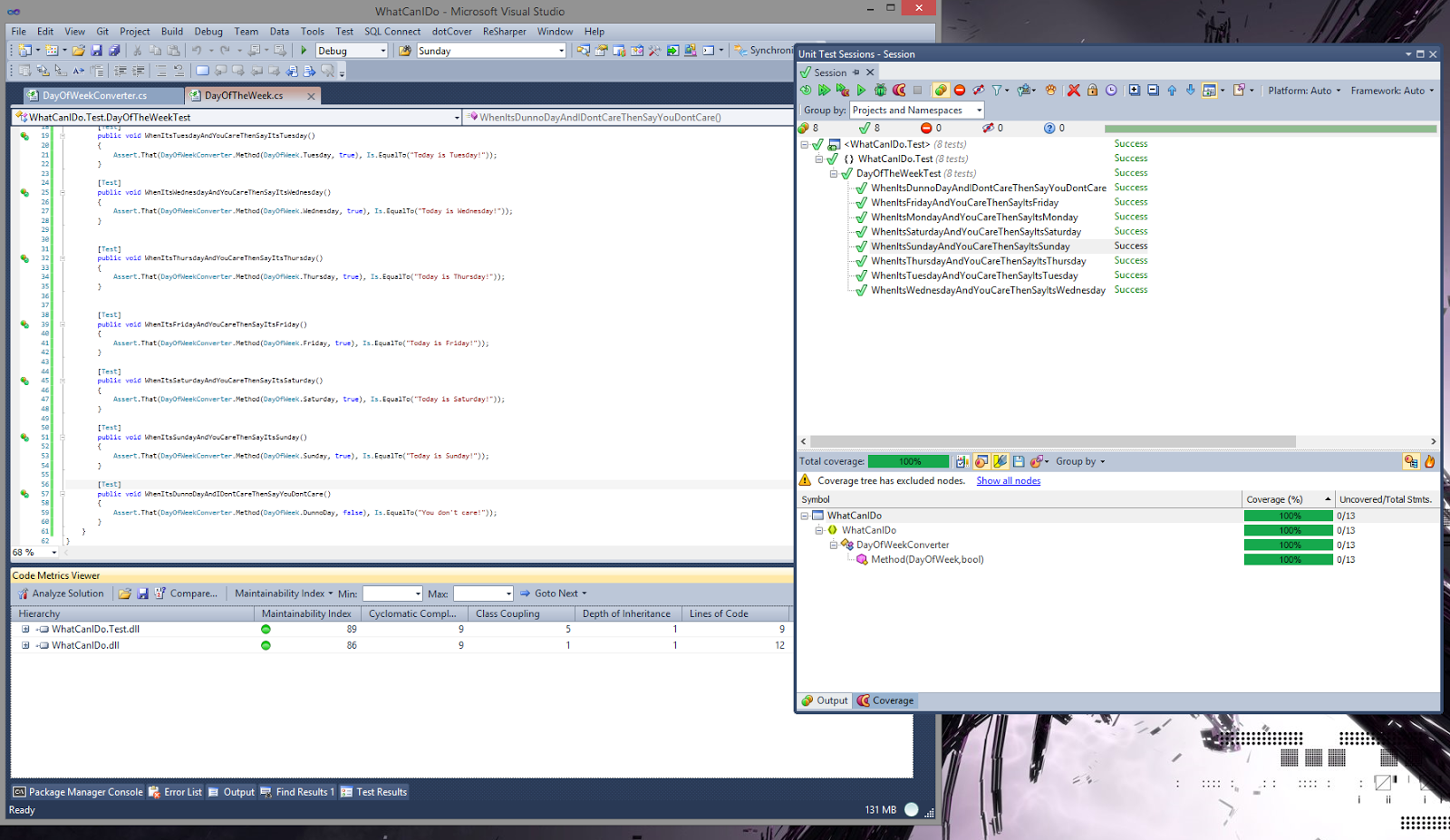
dotCover results after removal of 7 extraneous tests

Summary

In short, cyclomatic complexity is a brilliant metric for governing how many tests are needed in your solution. There are two main useful comparisons in isolation and teams should take heed:
  • If cyclomatic complexity is greater than the number of tests, then you're missing test scenarios and risk introducing bugs into the system. If there is a hole in a bucket, Henry can't carry as much water. Most Agilists should aim to get here as a bare minimum in today's industry.
  • If the cyclomatic complexity of a method is less than the number of unit tests around it, then you have over 100% coverage and you introduce waste into your process. This comes when you step agile up to the lean plate!
So to be lean, 100% should be the norm. Anything else is suboptimal or worse.