Wednesday, 10 September 2014

Going from Acceptance Tests to Code

When working with a dev hat on, I keep getting overruled in discussions by programmers who either don't seem to get what I am saying or don't seem to want to get what I am saying. One theme that comes up time and time again is the issue of acceptance testing and how to test. There is often the view that it is the QA's/BA's jobs to specify the acceptance test and that unit testing is the preserve of the developer, who only gets them when the QA's have finished, or just as bad, develops their code in parallel.

Now, this obviously creates the very silos that agilists always claim were 'bad' in traditional methods. I am not a great believer in 'owning' code and also believe that a generalist skill-set is better than a specialist one, as otherwise you get blockers when people are off on annual leave or sick, or you get massive contention on the times of these people. So this is yet another thing that narks me.

Hence, in the spirit of breaking these barriers, I am going to spend this blog post writing code.
In order to do that, we need a story card. So, let's have the following:

"As a tutor, I want to be able to recall the marks of my top 3 students at the end of the year to be able put them forward for end-of-year awards."

Simple enough. So using SpecFlow, MSTest, C# and SQL Server Express Edition, how do I turn this into code?

There are many ways to make this happen, including starting with a walking skeleton and pushing the acceptance criteria down through the layers until it exists in the database or by elaborating on the criteria enough to develop the example using design by contract.

Acceptance Criteria 

There are many ways to make this happen, but working with the tutor and using agile methods, we pick this ticket up, elaborate on it with the tutor and we can come up with something fairly reasonable using Gherkin syntax which represents this.

My personal favourite is using specification by example. This allows the dev, QA and BA to engage the product owner/customer in a role play session, defining at each stage an example, say, message passing, website form, document, customer service agent etc. that can tease out example scenarios with example data for each feature developers are being asked to deliver.

For example, the end result of this after interacting with this tutor may be:


Feature: TopFlight Students
 As a teacher, 
 In order to find the top 3 performing students,
 I need to retrieve the average student marks for the year 
 And pick the top 3

Scenario: Pick the top 3 performing students by average score
Given I have the following student marks:
 | ID | Surname | Forename | Score |
 | 1  | Joe     | Bloggs   | 55    |
 | 1  | Joe     | Bloggs   | 73    |
 | 2  | Freb    | Barnes   | 61    |
 | 3  | Jane    | Jonas    | 83    |
 | 4  | James   | Jonas    | 85    |
When I press retrieve
Then the result should be as follows:
 | ID | Surname | Forename | AverageScore |
 | 4  | James   | Jonas    | 85           |
 | 3  | Jane    | Jonas    | 83           |
 | 1  | Joe     | Bloggs   | 64           |


Having established the acceptance criteria here, we can develop the steps and use stub objects to return the expected values, which become something like the following skeletal SpecFlow steps file which tests the TopFlightEngine static class:


using System;
using System.Collections.Generic;
using TechTalk.SpecFlow;
using TutorMarks.TopFlight;
using Microsoft.VisualStudio.TestTools.UnitTesting;
 
namespace TutorMarks.TopFlight.Test.Feature
{
    [Binding]
    public class TopFlightStudents
    {
        // Added the student scores
        private IList<StudentRecord> studentRecords;
 
        [Given(@"I have the following student marks:")]
        public void GivenIHaveTheFollowingStudentMarks(
                IList<StudentRecord> studentScores
            )
        {
            studentRecords = studentScores;
        }
 
        [When(@"I press retrieve")]
        public void WhenIPressRetrieve()
        {
            // Press retrieve
        }
 
        [Then(@"the result should be as follows:")]
        public void ThenTheResultShouldBeAsFollows(
                IList<StudentRecord> expectedTopFlightScores
            )
        {
            IList<StudentRecord> actualResults = TopFlightEngine.RetrieveTopFlightStudents( 
                    studentRecords 
                );
 
            Assert.AreEqual( expectedTopFlightScores.Count, 3, 
                @"The expected number of results were not returned." );
 
            forint index = 0; index < actualResults.Count; index++ )
            {
                AssertPropertyEquality("ID", index, 
                    expectedTopFlightScores[ index ].Id, 
                    actualResults[ index ].Id);
 
                AssertPropertyEquality("Surname", index, 
                    expectedTopFlightScores[ index ].Surname, 
                    actualResults[ index ].Surname);
 
                AssertPropertyEquality("Forename", index, 
                    expectedTopFlightScores[ index ].Forename, 
                    actualResults[ index ].Forename);
 
                AssertPropertyEquality("Score", index, 
                    expectedTopFlightScores[ index ].Score, 
                    actualResults[ index ].Score);
            }
        }
 
        private static void AssertPropertyEquality(
            string fieldName, 
            int index, 
            object expectedElement, 
            object actualElement)
        {
            string CONST_DIFFERENT_RESULTS = 
                @"The property {0} for record {1} is unexpected. Expected {2}, Actual {3}";
 
            Assert.AreEqual(
                expectedElement,
                actualElement,
                String.Format(
                    CONST_DIFFERENT_RESULTS, new object[]
                            {
                                fieldName,
                                index,
                                expectedElement, 
                                actualElement
                            }
                    )
                );
        }
 
        [StepArgumentTransformation]
        private IList<StudentRecord> MapTableToStudentRecords(
                Table source
            )
        {
            List<StudentRecord> result = new List<StudentRecord>();
 
            foreach (TableRow row in source.Rows)
            {
                result.Add(new StudentRecord()
                {
                    Id = int.Parse(row["ID"]),
                    Surname = row["Surname"],
                    Forename = row["Forename"],
                    Score = float.Parse(row["Score"])
                });
            }
 
            return result;
        }
    }
}


Now, remember, for the sake of the illustration and learning why arbitrary test criteria in TDD is a bad thing, look at the bigger picture.

After eventually making the tests go green, the following can be seen (I should have been a poet):

namespace TutorMarks.TopFlight
{
    public class TopFlightEngine
    {
        public static IList<StudentRecord> RetrieveTopFlightStudents(IList<StudentRecord> studentRecords)
        {
            return new List<StudentRecord>
            {
                new StudentRecord() { Id = 4, Surname = "James", Forename = "Jonas", Score = 85 },
                new StudentRecord() { Id = 3, Surname = "Jane", Forename = "Jonas", Score = 83 },
                new StudentRecord() { Id = 1, Surname = "Joe", Forename = "Bloggs", Score = 64 }
            };
        }
    }
    // ... Located in another file
    public class StudentRecord
    {
        public int Id { getset; }
 
        public string Surname { getset; }
 
        public string Forename { getset; }
 
        public float Score { getset; }
    }
}


What pertinent things do you notice? Correct! It only returns the EXACT averages as the tutor expect to see them. This is your 'dumb' wireframe/pretotype. One thing it is NOT is a walking skeleton, as that implies a piece of functionality that manifests through all the connected components of an architecture as a tiny implementation (basically, not actually having any substance to it. Akin to testing with arbitrary data and making sure "...the web bone's connected to the service bone. The service bone's connected to the data bone...", jehee... see what I did there?). This precedes even that! It allows you to get feedback quickly to yourself and builds from the acceptance criteria to the code from the very beginning of a project.

This SAME  pretotype can then be elaborated even further with the tutor by adding more example scenarios. For example, it can be established that the 'mean average' (as opposed to modal or median) is the calculation that brings about the expected results.

For each part of the whole (let us call this part a 'unit'), when playing out the scenario with the customer, using these examples, their view would be as follows:
  1. Take the scores for each student (e.g. "Joe Bloggs"), who is identified by a single ID (the number 1)
  2. Add their scores up (55 + 73 = 128), keeping track of the number of scores they have (2 scores)
  3. Divide the total Sum of the scores by the number of scores they have ( 128 / 2 = 64 )
  4. This is your average score (so average score = 64 )
So, can you see what we have here? Correct! You have a series of test scenarios that you can use to substantiate the pretotype, which relate to the ORIGINAL acceptance criteria! As a result, everyone can see how the unit level code delivers the acceptance criteria all the way through the process.

Taking each step in turn and noting that we can then deliver the individual steps by developing units which use the examples in the steps as acceptance criteria. We then go on to deliver a unit testing class which tests for the correct number of results and then the average results etc. etc,

Benefits, Warnings, Tips

One thing that has consistently been a problem in the past is how to align acceptance and unit tests. If you don't have full code coverage at acceptance tests level, you run the risk of allowing development too much leeway in creating examples which are not aligned in other components of your architecture. That said, given acceptance tests tend to be slow in nature, you could trade off some acceptance specifics, that are low value or risk, such as exception cases, for unit test coverage in that domain, since the 'unit' is typically where such exceptions originate.

Developing unit tests back from the acceptance tests with examples usually give you the highest value cases and secondary scenarios, which automatically gives you unit test alignment with the value that the stakeholder wants. Build on those to then fill out the unit with exception tests, say, potentially mocking them out if you need to.


Tip 1: Take care that that acceptance tests and unit tests are 'joined up'.
This should automatically happen, but there are many a case where it doesn't. This is why working back from the acceptance criteria examples is best to do. If the examples are courses grained than you need at the unit level, discuss it with the stakeholder.


Tip 2: Know Your Context and Watch your coverage!
This is a contentious one. I am of the view that things should be covered 100% in some form. Acceptance tests really help cover at least 80% of the value. However, there are often edge cases and bugs which come about which resulted from unforeseen scenarios. Adding a test for the bug is great, as this fills the gaps, but be aware that it's possible to have acceptance tests cover 80% say, unit tests to cover 100% of the code, but you still have integration problems which result from the 'missing' 20% acceptance tests or bugs resulting from data you/the stakeholder hadn't thought of. This is why integration tests came about, but if you have 100% acceptance test coverage, you don't need integration tests at all, because that's already in the acceptance tests anyway.

This won't always be possible. For example, interfacing with some cloud providers. So know the context of the system and work with that to deliver right up to the cloud service boundary.

Also, don't forget that overusing mocks is a bad thing and unit testing just the edges around the value covered by acceptance tests (if they're not 100%) doesn't prove anything credible either, since you can't isolate an error in acceptance tests by the unit tests that way. I've illustrated the problem areas below, since they will need special attention. Perhaps another discussion with the business owner. Note, green includes unit test coverage and has been removed for clarity.

With mocks. Acceptance test in green, unit test coverage. Red indicates potential areas for bugs, so pay special attention to them.


Without mocks (or only at the extremeties) Again pay particular attention to the red areas.

One of the difficulties is that the red areas are points where the developers don't necessarily have enough information to go on. i.e. they can't set up their tests without potentially fabricating some tests data and the overall behaviour of the system may or may not be consistent with the information used in the other red area(s). Hence, your test suite has the potential to use different entities, with partial overlaps in fields, to get different results in these two different areas of the system.

So make sure that a combination of examples you use makes sense. This might necessitate checking what's in the tests already to make sure you don't create an absurd scenario, such as using random credit card digits for a number in a section of the site you're not interested in unit tests, only for someone else to develop a Luhn validation algorithm and it breaks in all these cases. Not nice to leave cleaning up that sort of mess to your colleagues!

Thursday, 28 August 2014

Drawback of Shared Service: Part 2, Improving on Shared Services

A month or so ago I wrote about some of the biggest drawbacks of shared services in today's market. There are folk out there who make their living delivering these shared services, so I was approached and asked why I felt such a need to denigrate them. That wasn't really the point of the blog and perhaps I could have phrased the somewhat 'tabloid' headline better, especially when I cited them as Evil (which in an accelerated delivery sense, they are but are so nice to reason with, even in purely SOA circles). However, it also became clear that mapping the flow of work through  business hasn't really been done by some in that camp before and hence they didn't have visibility of the actual flow of work through the system.

Kanban and visual management really helps make explicit the work that is goign on. Plus, shared services are only evil in agile and optimised worlds, where the fitness of a company is ingrained in a company's need to adapt and deliver at a fast pace. They form bottlenecks and hence constraints in traditional systems, even if they themselves deliver things quickly (i.e. they are suboptimal). The focus of the last blog was on these systemic issues, not on the individual services and I assumed that the shared services were in themselves optimised. Don't forget, constraints are a natural and expected concept in Systems Thinking and indeed, form a critical concept in the Theory of Constrains. When systemic problems they bring are solved, they are something I and anyone else working in business optimisation positions should be aware of and then look around to see where the constraint has moved to, because they will.

Revisiting Shared Services

Shared services are a stand alone service in a company. They may or may not have budgetary and reporting functions, may have all the elements to deliver a service end-to-end in their arena or perhaps most optimally, deliver business features to other services. They are often characterised as having one accounting cost centre, even if they cut across multiple skill-sets.

For example, in one company, an IT shared service may not have budgetary and HR control consist of:

  • Distinct Tech Support teams - With management
  • Testing teams - With management
  • Software Development teams - With management
  • System Operations/Technical/Network services teams - With management
  • Overall departmental/service management


In another company, their IT service may consist of:
  • Distinct Tech Support teams - With management
  • Software Development teams consisting of DevOps, BAs, QAs/testers - With team leads
  • System Operations/Technical/Network services teams - With management
And management of each team has budgetary responsibility etc.

And indeed, it could be fairly mature and have teams that delivers end-to-end ad support the application.

Getting teams to be more effective inside the bounds of a shared service is a noble goal, but the problem is the constraint then shifts to being a systemic problem, which is what I illustrated last time.

Is Optimising Shared Services Useless?

Not really. If you are moving from a traditionally hierarchical organisation to a flatter, leaner more agile one, it can be a very useful first step and indeed, almost always is. Just getting everyone in the same team who is responsible for delivery in that shared service ad visualising the work they are each contended for is an incredibly useful way to see how they are being pulled from pillar to post. 

However, further down the line, this ceases to yield any significant improvements in value delivery, simply because of the contention on the service as a whole.

If I had to provide my top-4 tips on how to transition from traditional shared services to lean, multifunctional teams, they would have to be:

1. Pick a Stakeholder's Departmental Concern 

Start with the needs of a stakeholder and map the flow of their end-to-end tasks through the entire organisation, noting the departments and functions it touches. 

This often manifests as perhaps a customer entity which starts as a form on a web page, then becomes a record in the DB, then becomes a task for an engineer to come out and do and a conversation that a customer has with a call centre representative when they register an account once the work is completed etc.

To illustrate this through a well known medium, in IT, this can often manifest as the ALM process, for example:

Mapping a sample software ALM to departmental functions

Once you have that list of departments for each individual journey, get everyone in that journey into one team. That way they are all aligned to that one value chain. Note the responsibilit numbers above and the team members below:

Collating members of the value chain into one team

2. Map & Optimise Implicit factors & Visualise EVERYTHING!

These are often 'invisible' supporting functions, such as internal technical support, network services, software licensing, recruitment of team members, capital expenditure for servers etc. These have an impact on the performance of the team, especially in delivery. 

Perhaps the most famous of these is the move to DevOps from SysOps, especially when capital expenditure for servers has traditionally taken a long period of time. First the server is specified, then it is requested by tech services, finance have to approve it, tech services have to build it, SysOps have to provision it on the network, then the system is deployed on to it before going live. Each of those context switches (which is effectively what it is for the server being switched) takes a significant period of time. 

Changing Capex to OpEx (e.g. by using PAYG Cloud Services) especially those coming in under delegated departmental financial authority (especially with the team accountant now being on board) then removes the need for the finance context switch and authorisation to occur, reducing the amount of items in the finance 'to do' list at the same time. This then means that SysOps/Tech services can provision services without the need to get finance authorisation, which is a significant enough saving, as it in turn reduces the lead time but also, if the SysOps staff members are then brought into the development team, this means the development team can then take the technical parts of some feature from inception to live without having to go outside the team, reducing the number of blockers they can't solve.

This can also be applied to HR, facilities, engineering etc. as long as the value chain make sense and the majority of their individual contribution is to this value chain and not some other.

3. The Value Chain is your alignment!

Overlay the journey in tip 1 onto your value chain. Make sure they match and identify and integrate where they don't. The actual journey is what you deliver, not the slide deck the value chain is present in, so that is your starting point and takes precedence. This gives you an aligned enterprise architecture baseline.

After that, look to transition to what your value chain 'vision' looks like on the slide deck, because I bet they don't match :) If you are lucky enough that they already do, or you've done the transition, make sure you're delivering the best value you can. That means revisiting the value metrics and seeing if there is a way to improve them. Chances are just aligning everyone will deliver improvements in itself, but there is always room for more :) 

For example, delivering faster improves financial metrics such as ROR, IRR and NPV which also improves ROI indirectly. Delivering predictably, reliably and with high quality reduces the need for contingency and some BAU processes. 

4. Munge Carefully, one change at a time!

When absorbing functions into teams, make the changes gradually. As usual, smaller changes are easier to integrate than larger ones ad this goes for people too. Smashing two tribes together only ever causes fights, so it is useful to be mindful of the psychology of folk. Indeed, in a lot of cases, most people take to the idea of being an team's authority really very well, even if they are reticent to leave the department they started in.

Conclusion

Creating Shared services which are fully self contained and are aligned to business value are the first step in what could be a long journey for some companies. It also has a very short shelf life, since they will get split and amalgamated into thinner verticals. As you can see fro the diagrammed example, we didn't map every single type of task each department had to do, just the ones that started a vertical and then overlaid the extraneous tasks over the top through implicit tasks which appeared as we looked at each journey.

There are many more tools and techniques which can be used to decipher the actual value chains, including some that can apply here. However, for brevity, hopefully this provides a reasonable start. Also, look into mapping the systemic flow of tasks, but do so for all tasks in the system. If you are looking for a reasonable primer on Systemic Flows, see Ian Carroll's blog for a really good start and primer in synergistic fluency.

Sunday, 17 August 2014

Q: What Do Agility & Astrophysics Have In Common?

There is an agile coaching game called the static points game. It's an extremely useful illustration of how complexity evolves from really simple rules which in the enterprise world, shows how businesses always change under multiple forces, which should be familiar to those in the change management space. I've played it twice, the first was an introduction by Ash Moran whilst I was at Laterooms.com and more recently with Ian Carroll. It's pretty simply, to play:

  1. Get everyone to stand up and move to the edge of the room (or form a circle if the room is too big) 
  2. Tell each person to pick two other folk from the group 
  3. The simple rule is to stay equidistant (the same distance away) from both of them. 
  4. Then let them go.

What you'll see is the group organise and shift about, jostling as the distances come to an equilibrium, then eventually settle. You can play it again, telling people to keep the original two people,  and see where they settle this time. Chances are they settle differently from where they did previously (a digital camera might and high angle come in handy for this variation of the game :).

Reset the game, and with everyone keeping their two folk, fix any one person from the group where they are, perhaps using a chair and send everyone else back to the edge of the room and play it again. They settle quicker. Do it again with that one person fixed, and photograph. You can keep fixing more and more folk and the organisation comes to settle much quicker, with much less movement.


What does this Illustrate?

As an abstract systems game, it naturally covers a multitude of arena!
  • How departmental level business changes relative to other departments as politics plays a part in how departmental heads compete for work or pass blame. Imagine the people in that game are working in an organisation and trying to balance the needs of two sets of stakeholders.
  • How uncoordinated systems work with one another as they evolve (which I believe is what you think this refers to here). Imagine the people in that game are subsystems taking with interfaces to two other systems.
  •  How uncoordinated work-streams work with one another as they evolve (in agile environments, this is what I think happens with shared systems. They pull against the shared systems). Imagine the people in that game are subsystems communicating with interfaces to two other systems.
  • It shows how complexity can manifest from a really simple rule-set. This one is self-explanatory. Intelligent agents (i.e. people, bees etc.) using a really simple rule can still produce a significant amount of very complex behaviour. This, like all the rest, is called [mathematical] chaos.
  • It shows that relationships are easily equally as important as the entities themselves
  • How organisms relate to one another
  • It is a manifestation of planets being influenced by each other’s gravity
Mathematically speaking, they are ALL a manifestation of what is called the n-body problem. The planetary example that ends that list above is where this originated.

A Lesson in Planetary motion

We orbit the sun because our mass is significantly less than it. The effect we have on the sun is near negligible. This is like a big CEO of a company, keeping things in order by imposing forces upon the lower weighted levels, who can’t respond in any meaningful or significant way. However, the behaviour of the system is predictable and has been like that for billions of years. With the big, overarching, autocratic CEO (or C-Suite) in it, and with the absence of any other influential factors, the environment rarely changes, so there is no need for it to change. That is one sun and several planets and moons and their orbits (statics and dynamics) that systemically stay the same for millions if not billions of years, even if what goes on on the surface changes. As far as systems are concerned, architecturally, these are all static points. That’s a high level block diagram!

However, in agile environments, you are empowering folk, quite rightly. Hence, the gravity they have and are allowed to have, relative to the system, is much higher. However, returning to the n-body system, If you have two equally weighted planets orbiting around each other, they will pull each other’s orbits. If you have three orbiting each other, it has been proven that the behaviour of an unconstrained system, is near unpredictable aside from very restricted contexts (i.e. akin to how often waterfall delivered on time and on budget, which some would argue has the same probability that our solar system came into existence the way it has :) Plus, because the class of problem is the same for all of the above, this chaos or ‘randomness’ applies to all of the above examples too.

OK, how can you test if the result is random?

Firstly, this is a complexity problem. You can't necessarily test the system internals [aka business] as a whole if the result isn't predictable or consistent. However, what you can test, is that the unit which is the individual person, does manifest the rules correctly! i.e. they keep the same distance from their two folk at all points of change, including all points of jostling! After all, most software systems test that rules manifest correctly. For example, you can't open a bank account if you don't have ID or you can't board a plane for an international flight without a passport. Each and every one of the individual entities, as well as the whole in deterministic systems, is defined by: 

  • A pre-condition, which includes the initial state of the system - The position they are in in the room 
  • An action - Someone moves
  • A post-condition - They have to remain equidistant

With an invariant that they have picked two constant people to apply the rule with.

Which in BDD/Gherkin syntax is akin to:

Background each person has two different folk to focus on
##...

Given the person is in the room
When someone moves
Then the person has to be the same distance from their left-person and right-person

Remember, a static point is not just the structure or entity, it is also the behaviour it exhibits. Hence, the best way to make a change and make it testable, with the minimum of risk. is to nail all but one of the folk (read systems, which include the entities and how they behave – that is the aggregate of business, application, data and technology for each feature), make that small change, test they manifest the rules, then release everything, make sure the system didn't disintegrate (i.e. all the other elements correctly adhere to their own rules, which may be the old ones), then for the next change, nail all but a different one, make a change, release etc. The key is to test that the one body itself adheres to the simple rule you want of it! This provides parallels in systems?

For example, if in the static points game above, if we took just one person (which is a business unit or capability), let's call them 'delta' and made the rule that they stay an arms length away from everyone else and can pull the folk together if they are not, then played the game again. They may get jostled about a bit by the rest of the business going about its [old] business, which is still testable, whilst simultaneously pulling the two folk to their arms length distance. Note, through pulling folk, the rest of the system, that means folk who have picked one or other or even both of the people pulled by delta, and their 2nd, 3rd and nth degree of separation, will also change. So this new rule influences the system as a whole, but crucially, the rest of the system adhered to the old 'equidistance' rule, which like the new one, you can still measure individually (as mentioned at the top of this section). You measure that Delta is doing their job by ensuring they keep their two within 'punch distance' at all points of change, i.e. jostling.

Conclusion

Trust me, this is a very difficult concept for some folk to get and it requires some 'micro-thinking'. Indeed, it always provides a learning point in communication to me. Whilst there is almost nothing anybody in the IT world can tell me about non-linear system dynamics, there is a lot I have to learn about communicating the concept across in language people understand. That is why I attend community events, such as TechNights, Lean Agile Manchester etc. it’s to learn to effectively communicate the ideas to people who do not have that bridge or background. I've been through this sort of discussion a couple of dozen (or more) times and I still communicate this wrong now, because there may be levels of knowledge or skill between the person I am trying to communicate this to and the understanding of non-linear dynamics that would help illustrate the benefits of the knowledge. I'd be interested to see how others communicate this to analytical and non-analytical audiences alike.

So the best I can do for now is probably illustrate it with video. In the external links below, take a look and see if the systems look the same as each other after they've been running for a while. Indeed, you can run the YouTube vids side by side if your broadband is up to it.

External Links
n-Body Gravity Simulation like folk at the edge of a room - https://www.youtube.com/watch?v=XAlzniN6L94
n-Body simulation with 50 million entities - https://www.youtube.com/watch?v=OJaE9J39A8s

VIew these two 3 body problems side by side:
https://www.youtube.com/watch?v=VX9IdCnNWJI
http://vimeo.com/11993047 (from 24 seconds in - This also has multiple runs with different starting points)

Tuesday, 8 July 2014

Kanban in IT: Why You're Probably DOING IT Wrong!

Despite it's age, especially in other fields, Kanban is a relatively new addition to the IT world. As someone who is easily just as inquisitive about the development process and working more effectively and systemically, when Kanban was mentioned all those years ago, I looked at the history of the process, put my mathematical hat on, my searching boots on and started to try to understand these systems in more detail.

For those who are not familiar with Kanban, it originated in the manufacturing world. Specifically, it stemmed from the study of supermarket demand in the 1940s which and later became the Toyota production system (TPS) in Taiichi Ohno's seminal work from 1988. Get that? Started in the 1940's! Some 60 years before IT ever got its hands on the idea.

The method became arguably the most solid foundation in Just-In-Time manufacturing bringing unparalleled and unmatched production quality and speed to the Japanese car market. As a child of the 80s, I remember the sheer envy of the rest of the world of the Japanese market, which at the time outshone the German market for efficiency. It even caused a plethora of Hollywood films about firms being subsumed (aiming to, or avoid) by Japanese companies, such was the dominance of the Japanese car market at that point.

Additionally, whatever you think of process improvement methods, Lean-Six Sigma and Kaizen both use Kanban process as cornerstones of process improvement techniques & there are a number of mathematical and statistical studies of the technique which have also delivered some heuristics to follow. So again, old hat.

As a software development professional, I use Kanban all the time and as an agile early adopter, I have done for a good, long while. However, one thing that always crops up, which I believe is fundamentally wrong, is the notion of tickets moving across the board as the work items themselves. I often have to reiterate the ticket isn't the work item, it's a representation of the needs of the work item. A Kanban signal!

Now, in true [just after] 80s style, you can watch some videos explaining the manufacturing equivalent of the pull system:

https://www.youtube.com/watch?v=w3Ud7pEhpQM

Kanban has been used in manufacturing, healthcare, baking etc. and the only one that I admit to taking umbrage at is the software dev Kanban and here's who. Pay particular attention to how this works! A key takeaway is that information flow, the ticket which includes the 'specification' of the batch size/container, flows from right-to-left, whilst the implementation (real thing) flows from left-to-right.

Self-flagellation? 

No, I believe in being realistically critical enough about our own work to find the points for improvement. Admittedly, some folk see this as me being negative and make no mistake, there are times I am especially when trying to get some teams to think about change is like head-butting a wall over and over or swimming through treacle - There are only so many times you can keep head-butting that wall before you cease to add value. So companies without the necessary buy-in can learn the hard way when their competitors overtake them and if some staff then leave or are made redundant, they company and staff find themselves without the requisite skill-set to compete with other candidates on the market. It is a huge problem in the IT world especially and one of the reasons why some people were forced out of the industry as agile methods took over.

We also need to reframe this as learning, not criticism. Especially when considering (For those of us lucky enough to have some understanding of optimisation), a theoretically optimal system isn't guaranteed to be unique in any situation! So you can get more than one optimum so there is more than one right answer at the time. In the case of manufacturing or economic systems, this is because there are often more variables than there are equations to solve them (implicit or explicit). So this naturally becomes an optimisation problem with almost always more than one solution, but those solutions do exist and can be found through iterative methods. 

Whilst I was involved in the creation of the mathematical algorithm and ran that derivative of IPFP for the UN Development Programme's JOrdanian Social Accounting Matrix in 2012 (based on matrix-raking - it's an iterative algorithm) Kanban modelling doesn't need that level of sophistication. For a lot of problems Linear programming is a sufficient way to look at these systems. However, this is outside the scope of this article, as much as it pains me to say it :) So I'll stick with giving you top-3 tips, but assume you're already segmenting customer feature end-to-end (i.e. entire thin Lines of Business).

TOP-3 TIPS


1. Kanban is a Pull-System

CORRECT! It very definitely is a pull system! So why are you pushing cards across a board? Stop doing it! Think about how you can signal that a task is ready to be pulled. Some folk use smaller green stickers/tiny post-it notes etc. 

In my mind, and this isn't shared by everyone (but everyone has been wrong before ;), the ticket represents a container for the item you're producing (whether that is a feature of a system, with many features going into an epic container for the MMF or MVP) or a physical item, such as a container for a 'Login page'. The item is not the login page itself.

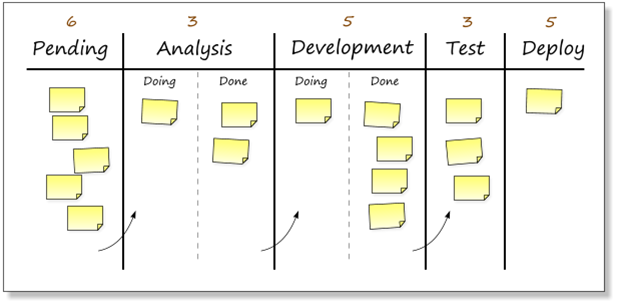
The filled container is what the customer wants. If you're Kanban process looks like the following deliberately not perfect example:

image from bob's lean learning

The arrows represent where the items go when they are pulled form the previous stage, not pushed once done. At the end of the flow, the deployed container is what the customer gets. The customer pulls this from the test stage once it's ready, which pulls this from the development stage once it's ready, which pulls this from the analysis stage once it's ready, which pulls the 'material' from the pending backlog once it's ready. The specifying pull-signal moves from right-to-left. From customer needs, which effectively specify the acceptance criteria for the system through behavioural tests (BDD/Gherkin) or even just BOLT ("As a... I want... so that...") through to picking up the raw materials (tools, projects, repos etc) at the very beginning. You'll note one crucial and perhaps controversial thing... DEVELOPMENT IS NEXT TO LAST!!!!

Before you start shouting off, this doesn't mean that developers are last, inferior or can be demeaned. After all, you're working in multi-function teams and this is a stage not your job or role right? 

Even if you are in charge of it and are feeling insulted or devalued now, ask yourself why that is? Are you protective over your role in the team? Is it Test-Driven Development you are practising? If so, what do you think that truly means? Does the customer care (or is their value measured) by the teasing out or refactoring of tasks which don't pass acceptance tests, glean feedback or deliver much needed value? No, of course not (you better agree!) because the old agile statement about the code being the final arbiter is complete rubbish and has been one that I've thought ridiculous from the start! Whether it delivers value is the true arbiter of the worth of the code and the efficacy of the team. All those feelings of anxiety that may manifest are indicators of 'threat' and dare I say, were felt by the people who were told to move to agile environments some 15 years ago at the turn of the millennium. Indeed, I myself felt them at the time and there is an important lesson in that.

Take a look at this video for 5S a lean manufacturing improvement vendor and see if you can spot some of the things which also conceptually apply to software development (SPOILER ALERT! "All of them") then think about how this can applied in your org:


Or how about this video of a an office space? I think there were more points in this for improvement (HINT: the business cards)


WATCH FOR: No visual indicators of 'ready', usually accompanied by people moving cards into the in-tray of the next stage to the right once complete. This is the same as using 'in-trays' and runs counter to Kanban. QA not being involved (or taken seriously at retrospectives).

TIP: Get small stickers or post-its to show that a task is ready to be pulled, or perhaps have a sub-column for tasks that area ready.

2. Pull-Signals Flow Right-To-Left

Information in the form of pull-signals makes its way from the right hand side of the board to the left hand side of the board. Compare this with a manufacturing plant, where different stages in the process often have differing levels of local inventory, for different parts of the whole. For example 4 screws are used to mount a single kickplate on a door which is pulled as a trolley of doors and kickplates, with the screws at the bench.

In software development a feature is a particular item of meaningful functionality. After going 'backwards' through the testing stage (which remember, is just the container/pull-signal for the work) this may get broken down into smaller architectural chunks, which may have TDD tasks wrapped around them. 

Can you see what I am suggesting here? Yes, QAs are effectively your architects. If you're a developer, then I expect there's PANIC! But again, it is TDD you're practising right?...

The truth of the matter is the market isn't currently aligned to this idea at all. Companies still value testers much less than they do development staff and as a result, most people with development skills do not move into testing roles else they earn around 17% less in salary terms, though the contract market is much better aligned. Until this changes, the motivation for better, more technical test staff will simply not be there.

WATCH FOR: Classic indicators of this are where developers run (and talk most at) the stand-ups, a developers is, say, a Scrum master or team lead, the developers drive change, look at technology choices before customer value, the retrospectives are not data driven or are otherwise poor and the team use only one type of testing process (such as TDD) with no attention to behaviour, increment size, load and/or performance testing. Whilst not exclusively the preserve of developers, it indicates both siloed thinking in job role and no strength being attributed to the test side of the team.

TIP: Encourage buy in from the team and make them aware that the QAs run the testing process. Encourage pairing for KTP and the breaking down of features led by the testers, not the development staff.

3. Business Analysts are also your Feedback!

More often than not, a business analyst is found on a team and they illicit requirements. They also look at the business process at hand and determine the value of the tasks but rarely do I see a business analyst be involved in decisions and reporting ROI and team and capability effectiveness. This is the missing link.

When working lean, the aim is to get feedback on how well the business vertical is working. A business analyst does exactly that! They have to look at the customer value of each and every story and determine the cost-benefit of doing each [thin business vertical] task. They will also help determine the Rate-Of-Return and the Return-On-Investment of a project in the customer's mind as well as look at the customer experience elements, both inside the outside the team. Together with the QA's they are crucial in determining how effective the team are, how well they are working together and determining the scope, location and exposure to any points of waste or constraints in the process. They will be skilled at determining the appropriate contextual metrics and constraints (a bank is different to a mobile social media app start-up) and monitoring the necessary measures of value.

WATCH FOR: Retrospectives without numbers or no change in waste, blockers or bug numbers in each iteration over a period of time or no predictability in flow. This is likely nearly every one you'll ever attend (and is why they're wrong). Some companies, such as Lastminute.com have moved up a level, but they are very very rare!

TIP: Get the business analyst to think about operational expenditure and how the team adds value. If you take the brave (but I think legitimate) step of align reward to profitability, then the business analyst will be crucial in determining that for the team. This will include finding the internal independent variables influencing flow, cycle-time and throughput/velocity, such as number of blockers, bugs, enhancements and other levels of waste.

Summary

Moving to lean from just plain agile is a tough ask for a lot of companies anyway, whichever field they're in. This article gives you necessary but not sufficient things to look for when walking the floor at your company. 

Note, there are better companies out there than us in other fields and we are guilty in the IT world of not being humble enough to understand that. It isn't that the problem of Kanban is any different in software or product development (at least I can't see a significant difference), just that our grasp about what a batch or container is, is very muddy. We can and do use story points, but need to attach these to features which combine into epics and hence make up MVPs and MMFs. Other techniques such as creating thin slices of functionality reduce the variance enough to introduce a reasonable element of predictability into the container or batch size. 

We also think that development is the cornerstone of the business, which any CEO will tell you, isn't true. It's an enabler, often to a product or service which pre-dates computers. If they could get something to do it as fast, but without the development overhead, they'd choose it over developing software any day, as there is much greater uncertainty in software. We already see this inside the IT space with build or buy decisions. So the role of business analyst and QA is crucial in process optimisation and it certainly isn't the preserve of the development team.

Teams inside and outside organisations need to make sure they understand that they are also part of the value chain. Your customer takes a problem, adds value in the solution they create (which includes the software they get you to write) and 'sells it on', providing a solution to their own customers, who may be Joe Public. If you've worked in B2C or B2B service companies before, this is always the case. Being in IT doesn't lose you the economic reasoning and truth be told, in capitalist environments, I think that's unforgivable if you think that's the case. 

Happy Leaning!

Tuesday, 1 July 2014

The Drawback of Shared Services

In many organisations, the concept of shared services is a pretty standard one. A shared service doesn't sit on a line of business, but is a cross cutting concern for across all lines of business. Examples of shared services are Human Resources, Marketing, IT, Finance and Regulatory Compliance.

Shared services came about because it's easy to segment such business functions into individual cost centres, potentially even into single accounts within a company's CoA (aka charts of accounts) which do make things much easier to report on. They also seem to have evolved functions at board level, such as CFO, CIO and CTO.

In recent years, it has become clear that this is a somewhat wasteful idea for a number of reasons and in the reporting sphere, not least because the end of month, quarter and annual reports and management accounts occur so infrequently relative to the lines of business operating all the time. However, there is an even bigger problem with this and it is the level of complexity this introduces into the organisation's operating model which happens to also mean that any operational task spanning multiple shared services contends for its time, is more complex to manage, passes through several chains of responsibility and due to the contention, generally takes longer to pass through the operating chain. For this intro, I will skip a significant portion of the maths, but the whole process of illustrative relevance is based around queuing theory.

Modern methods which aim to make organisations more responsive, such as Lean Start-up or agile software development, have inadvertently stumbled onto the answer. The reason they address this pain point so well is they amalgamate functions of all the various shared service centres into one, self-sufficient team. This type of organisational unit makes it really easy to manoeuvre in the space, shortens the time through the queue (aka the cycle-time) and inherently reduces complexity. Today I'll work through an example of the problem and compare this model to the newer, more agile cross-functional teams.

Traditional Hierarchy

In a traditional shared services hierarchy, you may have a chief operating officer who is responsible for the operations of the enterprise, which will include operational services, call centre management and such like. A CTO or CIO who has responsibility to deliver IT shared services. Some companies have CMOs, of course, CFOs exist etc. What is often correlated with that board structure is a hierarchy of specialisms. So an accounts division or department, a marketing division or department, an information systems division or department.

The interesting thing is that managers who have been through typical managerial courses, especially at MBA level, will have drawn up 'value chains'. These chains start with a raw material, and refine it into an end product. Alternatively, they begin with a customer entry into the system and travel through a series of steps, services or stages through the organisation before coming out at the other end, healthier, wealthier and wiser.

Consider the following organisation:

Typical organogram

Let's suppose this represents ACME plc. That wonderful road-runner extermination device provider. Coyote is getting old and needs ACME, who he has bought products from for decades, to come in and do the extermination for him. For this, there are a number of processes at work.


  1. Coyote, an existing customer, contacts the Customer Services department 
  2. They are put through to sales and purchases a consultation with an engineer. 
  3. The Sales adviser finds Coyote's details in the system and created a sales entry for an engineer visit.
  4. Through communications: 
    1. Engineering gets a request which waits in a queue until an engineer is assigned. 
    2. Legal prepare a new agreement for the extra work and send it out
  5. Engineering schedule their work and assign an engineer to come out, but not before conducting a quick risk assessment.
  6. A notification message is returned to a CSA to notify Mr/Ms Coyote (could you tell?) that they should expect a visit in some 8 hour window on a day some time from today.
  7. An engineer arrives at Coyote and does whatever business they do.
  8. The engineer finishes the consultation and registers the completion of the job.
  9. ...Which triggers a journal entry in Accounts, incrementing the bill which in turn formalises the contract. This waits in respective queues until officers from each department get to them.
  10. At the end of the month:
    1. Accounts run a report for the board on the sales which include Coyote's new order and...
    2. Marketing Analysts determine the performance of the previous month's sales v costs and effort and adjust for the next month. This is reported to the board and...
    3. Marketing prepare a press release to tell the world they helped Coyote finally catch roadrunner.
    4. Credit control raise invoices for all purchases, including Coyote's.
If we map this to the departments and division which the order touches (which remember, is a proxy for the view of the customer ACME have):

ACME activities in Coyote's Value Chain

What's wrong with that?


...I hear you ask. Well, if every department reacts as soon as they get the notification, absolutely nothing. However, in reality, this never happens! Different types of tasks contend for personnel's time. Crucially, because it's a shared service, Coyote is not the only customer that each shared service in ACME has, nor is Coyote's request the only type of request that a department processes (it's the nature of shared services after all).

ACME, having branched out, now have clients including Family Guy Peter Griffin, Chief Wiggum from The Simpsons and Roger Rabbit all wanting different things from the sales people or customer services, maybe calling up customer services to get in contact with tech support etc.

So let's add some numbers to that workload. The arrows represent how long it takes one [red] item to flow in and then out of each subsystem. Effectively, for tech guys, this is your departmental 'cycle-time' and is the difference between the arrival time and the service time. The red dots, where highest priority is reserved for the item on the top right, denote all the work there is and X is Coyote's task which passes into each department at that position in the work queue.

Aggregate workload


In each subsystem, counting each dot from highest priority to Coyote's cross (inclusive) and multiplying it by the time in each corresponding arrow, we get the time that Coyote has to wait. Doing this for all subsystems to the point at which Coyote gets a bill, marketing get an idea of whether their latest marketing campaign has worked, the board get a view of how sales of the consultancy service are doing etc. is:

Total flow of Coyote's new sale

Note that due to the request being able to come in at any time in the month and us using the very best case of the final day before the reporting run, that is an absolute minimum of 201.75 hours! 201.75 hours! At best over 25 days! That is a minimum of 25 days (and maximum of 55) before marketing can get an understanding of whether or not their campaign worked; the data showing up on the financial reports; the PR exercise coming through (potentially allowing your competition to get in before you with something more interesting for your customers); and before an understanding of your company position can be made! Not to mention crucially, that's 25 working days for your customer to get through this business process! If your cool off period is 14 days, what do you think this leaves them with? The road-runner is certainly long gone!

Working More Effectively

The key to being agile is responding to change and hence knowing faster, working faster and hence reacting to your market when you know you need to change. To 'know it' you need to be able to sample the effect on your market of a campaign and your customer's journey is crucial in this respect.

In this scenario, think about switching capabilities from horizontal structures built around the technical services your company provide to each other department, to a fully aligned business process with one member of each of the departments concerned in one, single, cohesive team. The work is also aligned so that it doesn't go out of order. This time the team consists of all members of operational staff and they focus on each case as it comes in, aside from the engineers, who have to take 2 days to schedule and work on their tasks in bulk, as they are out on the road. Let's assume that we remove 50% of the types of task that each department member deals with, so they focus only on this service. The reduction naturally means that they address needs that come in more frequently, using only one type of process, which  naturally reduces context switching. To keep things simple, we'll assume a zero-cost  context switch for this demo and we can imagine the saving not context switching gives. It will just add to the benefit.

There is always a way to improve. However, a first transition may yield:


New flow arrangement

Conducting the same analysis on the above yields.

Newer, aligned processes

WOW! What happened?

That's a bit of a difference eh? Now ACME can see the effects of a marketing change on Coyote (or anyone else) in less than a week! The removal of invoicing from the month-end shared service process also both shortens the cycle-time AND reduces variance! Imagine that? The ability as a CEO or COO to know how your organisation is doing and you will not be more than 1 week out of date and be pretty certain of the result! This compares to more than 5 weeks to up to 9 weeks in the previous example. That means you can assess your market standing in less time and know when to change with a high level of certainty. It also means you don't spend so much of your revenue if a process doesn't work. Given the fixed costs of ACME's wage bill and overheads, it would be paying 5 weeks worth to find out what you could have done in less than a week! That means at worst, you are 5 times more efficient and being aligned to the appropriate value chain, shifting 5 times as much traffic through ACME's system translates to being around 5 times more effective! Thinking about this as a factor in the Rate-of-Return of an investment and suddenly this looks very good indeed!

Summary

The process above shows the difference that the use of multidisciplinary teams and systems can have on your business process. I've left out some of the complex details, such as task variance and hence system variability.

Make no mistake, moving to a more agile business architecture is a culture shift, requiring a significant change in mind-set. Most organisations and indeed managers have spent a lot of time being told that shared services are the way to go and most staff assume hierarchies are the norm. After all, we get 'promoted' and gain higher salaries for higher positions. Hence, changing that will require small, careful, iterative change management, aligning services that already have some overlap with (and hence sympathy for) other services is the path of least resistance and the best road to travel. Take care to run those for a little while and see how it copes. Address issues as they arise and see where the system constraint moves to next (a la Theory of Constraints).

Whilst I am certainly can't advocate the removal of shared services where they are already aligned with the value chain, customer experience or workflow, I do caution that you look out for 'shared services' that appear to be essential to the operational flow, as these are the ones that need to be carefully reshaped. Happy reorganising!

Monday, 16 June 2014

Network Analysis: The 2nd Coming

Many moons ago, when I was young and you were even younger... that's not strictly true, I am probably younger than a lot of you even if the face in my mirror doesn't show it... techniques such as PERT and network analysis were fairly mainstream. Indeed, process improvement methods such as Kaizen and Six-Sigma still use network analysis as a mainstream tool to flesh out some of the flow in much the same way as modern systemic flow diagrams are used to track flow of working software from business ownership to production.

A fellow HiveMind expert practitioner, Ian Carroll uses presents systemic flow mapping in his website, which is well worth a read if you're not familiar with the concepts. He also expands on the evolution of this through different stages or 'mindsets', each of which brings benefit and adds to process maturity.

There are many benefits to mapping your process this way. Flow is one thing, as following that chain back to front you can find the bottlenecks in your system. However, as with a lot of agile techniques, a lesser known benefit is that it allows you to understand risk very well. Systemic flow gives these classic techniques of applied mathematics a new lease of life, especially when considering it as part of base-lining business architecture or business process during a transformation programme and using systems thinking approach.

The Problem

Having mapped a systemic flow, or when creating a classic PERT chart in ye olde world, you often find a series of dependent tasks. That in itself is cool and systemic flow mapping doesn't add much that's new in that regard. In PERT, each stage of a chain had a probability of hitting its expected date m (the 50% threshold) and a standard deviation of s. I'll save the details of that for another day, but the important thing to note is there is a level of risk around this and this risk would propagate through a chain.

Now substitute the term 'statistical dependence for 'risk' in my previous sentence and read it to yourself. I hope you can see how this more general concept can be applied to any chain of any type and can help you understand trade-offs as well, such as parallel tasks versus risk.

To illustrate this, consider the two chains below. The GO LIVE is specified for a particular date in the future, whether a hard deadline through a compliance or regulatory reporting requirement, competitive advantage in seasonal industries or other such reason.

Sequential Chains


Sequential task processing

Here there are 3 tasks that need to be completed. The percentages show the probability that a task will complete 'on time' (either in waterfall projects, or indeed, delivering those tasks in a sprint). The tasks are effectively mutually exclusive, given they don't occupy the same probability space, but they do have a dependency, which means that the probability of their success is dependent on the task before. For those conversant with statistics, you'll recognise this as:

This level of uncertainty is normally gleaned from previous performance and 'experience'. For example, manufacturing processes or system design activities. I previously covered how to reduce these risks by chopping up tasks into thin slices, as improves the variance and hence certainty.

So considering the chance of Going live on time, all tasks have to complete on time. So the probability of completing on time is simply the multiple of all the success probabilities, given these conditions:

Sequential Conditional Probabilties


So a 28% chance of completing on time!

Shock horror!

Parallel Tasks

"Cha-HAAAA! We'll just run the tasks in parallel!"...

...I hear you cry. OK, maybe not quite like that (stop with the mock Kung-fu already!). The point is, contrary to popular believe, this only improves the probability of success if running those tasks in parallel then gives each task a greater chance of completing before the GO LIVE date! After all, they all still have to complete:

parallel version of the same tasks
In this scenario, the go live can only happen when all individual components come in at the same time. Hence, we can model this with non-conditional probabilities and yet again, the chance of hitting the deadline is:

However, most of the time this does result in some improvement in probability of success, but not usually as much as you think, as workload expands to fill the time available for it (Parkinsons Law). It's what project crashing was in the original PRINCE method, but because of this darn law, it never changed the risk profile (aka probability density function) and because the tasks were so big, the uncertainty around them was extremely high anyway.

I have come across parallel tasks like this several times, where say, Task 1 is the hardware platform, Task 2 is the code and Task 3 is a data migration. This is risky!

The Solution

As per vertical slicing, the key is to segment the tasks so that each can be deployed as a separate piece of work, able to deliver value to the organisation even if the rest of the project doesn't make it, is canned, or is late. It's about breaking the dependencies all the way along the chain, so that the statistical fluctuations of ToC are removed (so if the statistical fluctuations do happen, and they will, who cares?) for those of you familiar with theory of constraints or queuing theory. Looking at how this would works:


Three separate deployments to live

This time, tasks 1, 2 and 3 all deploy functional projects into production with the same risks as before. Looking at the individual risks, they are 50%, 80% and 70% respectively. Given the overall success rate of both the previous methods was 28%, this is a significant improvement, without even considering the real life benefits of greater certainty.

You can apply this thinking to much more complex streams of work. I'll leave the following exercise for you readers out there. Take note that the conditional probability 'carried over' to the next task has obviously got to be the same for each successive task. For example, Task 1 has a 60% chance of coming in on time and hence Tasks 2 and 3 both have the same probability coming in. I know how keen you are to give this a go ;)

Give this a go!

Conclusion

As you can see, where an organisation hasn't made it to the "Mature Synergistic Mindset" that Ian Carroll introduces in his blog (i.e. vertical slices) the structuring of projects and programmes can rely very heavily on this sort of process to find where stuff goes. Risk is only one aspect to this. You can use the same technique, where the arrows map waste time (i.e. time spent in inventory) and then use say, IPFP or linear programming with appropriate constraints to find an optimum point.

However, be careful that this is an in-between technique, not the goal. The goal isn't to have the analysis, it is to make your process more efficient by reducing dependency, and the impact of statistical fluctuation on your project.

Monday, 2 June 2014

The Smaller The Better

A while ago, I wrote a couple of posts about agile estimation and specifically, how I evolve estimates as projects run. I also wrote about the #NoEstimate movement what I take away from that view of estimation.

There is also a little programming exercise I was shown once, known as 'the Elephant Carpaccio' by Alistair Cockburn. One of the agile signatories I have a lot of time for. The aim of the contemporary version is to find out how thinly you can slice an elephant (aka your code) so you can write a test, code and then deploy a tiny tiny change, perhaps even one single line, into production.

What is interesting is that the smaller the change, the less the variance on that change. I sometimes do this by asking a group of folk to estimate the size of a line, which is usually quite small (in the order of an inch or so) and then ask folk to estimate the size of a much larger [elephant sized] line. What you almost always see is the standard deviation of estimates of large line size are almost always much higher than those in the smaller ones.

You see this in both story point estimates and indeed the variance of waterfall/RUP/no-method projects as a whole. No doubt we've all been in companies where small projects haven't really been that late, or cost that much more than predicted, whilst larger, more complex projects have taken or cost several orders of magnitude more (luckily, not that many at all for me).

Now, you should know by now that I like to prove things. Using empirical data and statistics to find out perhaps useful angles on things or validate a hypothesis. This case is no exception. I am going to use a previous dataset for this, gleaned form issue tracking tickets, their estimates and the cycle time of each ticket (duration the ticket spent from being opened to being closed at done).

Basically, I am testing the hypothesis that the standard deviation of higher valued tickets is greater than lower valued ones.

Method

Taking the number of tickets, their point sizes and their durations, I constructed a table of averages versus standard deviations for all Fibbonacci sized ticket (1,2,3,5,8).

Results

The results of the analysis are shown below:


The key thing to note is that the standard deviation for a 1 point story (+ or - 1.088) is significantly smaller than any of the others, with intuitively, an 8 point story having a larger deviation.

Why Care?

This is important because if you want a level of predictability, not just with time, but with effort, cost and anything else, the indication is to make the stories as small as possible.

The key thing with agile processes, is they fall into a class of statistical process. Specifically, an Ito process, akin to Brownian motion (I know, this is where it gets sexy).

Each individual ticket can be considered to have a 'predictable' component and a random variation around that. Stochastics is more than pure probabilistic methods, either in classical statistics, where predictability is not assumed to exist at all, or Bayesian statistics (where the posterior probability is gained by improving the a priori statistic, given the presence of new empirical evidence). For devs this is like knowledge improving as you gain more knowledge of the domain, which manifests when the team 'learn' through experience (I personally think Bayesian statistics holds the greatest promise of modelling an agile development process by far. Another story for another day). Stochastics assumes there is a level of determinism and a random component which us agile practitioners could consider to be caused by sickness, additions of new folk, unforeseen circumstances, team members leaving, meddling or whatever else can affect the flow of the team.

The result of the above experiment, as well as carpaccio exercises and my 'estimate the line' game all seem to suggest that if we make the tasks as small as possible, simultaneously reduce the variance. Eventually you'll find the variance from the expected time is so small as to be negligible. So keep things small and keep your chances of success high!